Quando un utente visita il nostro Sito, alcune informazioni possono essere archiviate o recuperate dal suo dispositivo, soprattutto sotto forma di cookie. Utilizziamo i cookie necessari per il buon funzionamento del Sito, come pure i cookie statistici e di marketing per misurare l’audience e personalizzare i nostri contenuti. Per la gestione delle preferenze relative ai cookie e ai consensi espressi dagli utenti, ci avvaliamo delle soluzioni fornite da Google. Maggiori informazioni sono disponibili anche nell’informativa Google Responsabilità per i dati aziendali.
In questo Centro dei cookie, l’utente può effettuare le proprie scelte sull’utilizzo dei cookie: accettare o rifiutare alcune categorie, accettare tutto o rifiutare tutto. Per avere informazioni dettagliate sull’insieme dei cookie utilizzati in queste tre categorie, consultare la nostra informativa sui cookie.
Si segnala che la disattivazione di alcuni cookie potrebbe limitare determinate funzionalità del sito e influire sulla qualità dell’esperienza di navigazione e dei servizi disponibili.
Cookie necessari
I cookie necessari contribuiscono al corretto funzionamento del Sito, in quanto attivano funzionalità essenziali come la navigazione e l’accesso alle aree protette. Questi cookie non possono essere disabilitati nei nostri sistemi.
Cookie statistici
I cookie statistici ci aiutano a comprendere in che modo i visitatori interagiscono con il nostro sito, raccogliendo e comunicando informazioni sulla navigazione. Questi cookie permettono di identificare le pagine più e meno consultate e di migliorare la performance globale del Sito.
Cookie di marketing
I cookie di marketing sono utilizzati per divulgare pubblicità pertinenti e misurare la performance delle campagne. Scegliendo di non abilitare questi cookie, l’utente continuerà a visualizzare le pubblicità, ma saranno meno adatte ai suoi centri di interesse.
L’utente può scegliere a quale fine possiamo raccogliere e utilizzare i suoi dati tramite i prodotti Google.
Memorizzazione utente: per abilitare tecnicamente le funzionalità pubblicitarie.
Dati utente per la pubblicità: per permettere l’ottimizzazione delle nostre campagne pubblicitarie.
Personalizzazione delle pubblicità: per adeguare le pubblicità agli interessi dell’utente.
Dopo tre anni, le ragioni per investire in Transition Materials sono ancora più forti
Laurent Joué
Head of Systematic Alternatives and Lead Portfolio Manager
Marc Pellaud, PhD
Lead Portfolio Manager
Thomas Höhne-Sparborth, PhD
Head of Sustainable Investing
Stephen Benson
Equity Analyst
punti principali.
I materiali della transizione sono sostenuti da trend strutturali di lungo periodo, tra cui decarbonizzazione, elettrificazione, sviluppo delle infrastrutture per l'intelligenza artificiale e crescente scarsità delle risorse
Lanciata tre anni fa, la strategia Transition Materials di LOIM combina un'esposizione mirata alle materie prime della transizione con un processo d'investimento sistematico basato sul controllo del rischio
La tesi d'investimento si fonda sulla crescita della domanda e sui vincoli strutturali dell'offerta di materie prime essenziali per i sistemi tecnologici, energetici e industriali del futuro.
Negli ultimi tre anni si è ulteriormente rafforzata la nostra convinzione che le materie prime legate alla trasformazione tecnologica e alla transizione verso un'economia a basse emissioni rappresentino una delle opportunità di investimento più interessanti nel lungo periodo.
Sia l'andamento dei mercati sia i fondamentali hanno confermato la direzione che avevamo individuato al lancio della strategia, nel maggio 2023. La crescita della capacità di produzione da fonti rinnovabili, l'accelerazione dell'elettrificazione e il rapido sviluppo delle infrastrutture a supporto dell'intelligenza artificiale stanno alimentando la domanda di materie prime critiche. Allo stesso tempo, in molti mercati l'offerta continua a rimanere limitata.
Dal suo lancio, la strategia Transition Materials di LOIM ha dimostrato di sapersi adattare a questi cambiamenti. Essendo una delle poche strategie focalizzate esclusivamente sulle materie prime della transizione, senza esposizione a petrolio e gas, riteniamo di essere ben posizionati per continuare a cogliere le opportunità offerte da questa trasformazione.
Iscriviti alla nostra newsletter mensile.
Grazie per esserti iscritto alla nostra newsletter mensile!
Si è verificato un errore durante la registrazione dell’abbonamento. Invia un’e-mail a loim-digital@lombardodier.com.
Conferma della validità del nostro approccio
Transition Materials offre un'esposizione, tramite contratti futures, a un ampio universo di materie prime essenziali per l'economia globale del futuro. Dalla sua nascita, la strategia ha registrato una performance superiore rispetto al benchmark (Figura 1)1 a conferma della solidità dell'approccio adottato.
La strategia rappresenta inoltre una potenziale copertura dall'inflazione e una fonte di rendimento diversificata, grazie alla sua bassa correlazione con le obbligazioni e i mercati azionari globali, pur mantenendo una forte esposizione alle materie prime. I dati storici mostrano una correlazione di circa 0,1 rispetto al Bloomberg Global Aggregate Treasuries Index, 0,3 rispetto all'MSCI World Index e 0,7 rispetto al Bloomberg Commodity Index2.
FIG 1. Performance lorda della strategia Transition Materials (composito)3 rispetto al benchmark nei primi tre anni
Nel 2025, la nostra tesi d'investimento ha trovato ulteriore conferma. I mercati hanno infatti iniziato a prezzare in misura crescente l'impatto dei cambiamenti strutturali che stanno trasformando l'economia globale, nonché i crescenti squilibri tra domanda e offerta di numerose materie prime industriali.
Nel 2026, il contesto di mercato si è rivelato più complesso nel breve termine. Le tensioni geopolitiche, le dinamiche commerciali e l'incertezza sul fronte delle politiche economiche hanno alimentato volatilità e condizionato periodicamente il sentiment degli investitori nei confronti degli asset legati alla transizione.
Nonostante queste sfide, la strategia ha mantenuto una buona tenuta, beneficiando del contributo di diverse materie prime chiave, tra cui rame, alluminio, litio e nichel. Al tempo stesso, i principali driver strutturali della domanda restano pienamente intatti: dallo sviluppo delle infrastrutture a supporto dell'intelligenza artificiale alla continua espansione della filiera delle batterie. Trend che continuano a sostenere una solida tesi d'investimento di lungo periodo, indipendentemente dalle dinamiche dei mercati del petrolio e del gas.
I risultati ottenuti finora confermano la nostra idea che, nei prossimi anni, la domanda di alcune materie prime crescerà e cambierà profondamente a causa della transizione energetica, dell'elettrificazione e dello sviluppo tecnologico. Per questo, tre anni fa abbiamo modificato la nostra strategia sulle materie prime, creando Transition Materials e concentrandoci sui materiali che riteniamo saranno i principali beneficiari di questi cambiamenti.
FIG 2. Indicatore sintetico di rischio della strategia Transition Materials4
Una svolta strategica nel nostro approccio alle materie prime
Il 2 maggio 2023, pochi giorni prima che l'Organizzazione Mondiale della Sanità dichiarasse la fine dell'emergenza sanitaria globale legata al COVID-19, LOIM ha trasformato la propria strategia Commodity RP (Risk Premia) in Transition Materials. Con il senno di poi, questa evoluzione si è rivelata particolarmente tempestiva, anticipando un nuovo contesto economico e geopolitico destinato a ridefinire i mercati delle risorse e delle materie prime.
La strategia Transition Materials affonda le proprie radici in un lavoro di analisi sviluppato ben prima del 2023. LOIM aveva infatti progressivamente ampliato il proprio framework di ricerca per incorporare i cambiamenti strutturali di lungo periodo che interessano l'economia globale, estendendo tale approccio a diverse asset class, tra cui strategie azionarie tematiche e soluzioni multi-asset.
Materie prime strategiche al centro della transizione
Le materie prime hanno rappresentato una naturale estensione di questo approccio. La consapevolezza che la transizione verso un'economia a basse emissioni di carbonio richiederà ingenti quantità di risorse ha infatti portato a riconsiderare i tradizionali modelli di investimento nel comparto.
Piuttosto che considerarle una asset class prevalentemente ciclica, legata all'andamento della crescita economica globale, abbiamo iniziato a considerarle asset strategici alla base delle trasformazioni strutturali in corso.
Grazie a un'approfondita collaborazione con il team Roadmap Research, abbiamo approfondito l'analisi dei principali fattori destinati a sostenere la domanda nel lungo periodo, tra cui:
l'elettrificazione che richiede un significativo incremento dell'utilizzo di metalli come rame e alluminio
le tecnologie per le energie rinnovabili che dipendono da minerali critici quali litio, cobalto e nichel
l'ampliamento delle reti elettriche, delle soluzioni di accumulo e delle infrastrutture digitali che intensifica ulteriormente l'utilizzo dei materiali.
È quindi emerso con chiarezza come i vincoli strutturali dell'offerta siano destinati a coesistere con una crescita sostenuta della domanda, creando condizioni favorevoli per specifici segmenti del mercato delle materie prime.
Questa convinzione ci ha portato a concentrare l'universo d'investimento sulle materie prime direttamente legate alla transizione energetica e ai più ampi cambiamenti strutturali dell'economia. Il nuovo framework si fonda sulla nostra consolidata esperienza negli investimenti sistematici basati sul rischio, integrandola con un approccio di allocazione guidato dai fondamentali.
Il nostro approccio: convinzioni fondate sui fondamentali, implementazione sistematica
La strategia LOIM Transition Materials si basa su due pilastri fondamentali:
Selezione delle materie prime rilevanti per la transizione
L'universo investibile comprende esclusivamente futures su materie prime che svolgono un ruolo essenziale nei processi di decarbonizzazione, elettrificazione e sviluppo di infrastrutture sostenibili
Costruzione sistematica del portafoglio basata sul rischio
All'interno di questo universo, le allocazioni sono determinate attraverso il nostro consolidato framework quantitativo, con l'obiettivo di garantire diversificazione, controllo del rischio e un disciplinato processo di ribilanciamento.
Questo approccio unisce la disciplina di un processo d'investimento sistematico a una forte convinzione sui trend strutturali di lungo periodo, maturata attraverso un'approfondita attività di ricerca. Ne deriva la capacità di adeguare in modo dinamico le esposizioni del portafoglio, mantenendo al contempo un orientamento coerente verso i principali fattori di trasformazione dell'economia globale.
Geopolitica e sicurezza degli approvvigionamenti
Dopo il riposizionamento della strategia, il contesto delle materie prime ha subito profondi cambiamenti. Le tensioni geopolitiche, in particolare il conflitto tra Russia e Ucraina e l'instabilità in Medio Oriente, hanno messo in evidenza le vulnerabilità delle catene di approvvigionamento globali, contribuendo ad aumentare la volatilità nei mercati dell'energia e delle materie prime.
Parallelamente, i governi hanno iniziato a considerare la sicurezza energetica e degli approvvigionamenti come una priorità strategica al pari della decarbonizzazione. Questa evoluzione ha favorito una maggiore frammentazione economica, il rafforzamento delle politiche di controllo sulle risorse e un crescente interventismo industriale.
Di conseguenza, la sicurezza degli approvvigionamenti è diventata uno dei principali fattori che influenzano i mercati delle materie prime, i flussi di investimento e le dinamiche di prezzo.
Elettrificazione, energie rinnovabili e intelligenza artificiale
I vincoli dal lato dell'offerta si stanno confrontando con potenti driver di crescita della domanda. L'elettrificazione, lo sviluppo delle energie rinnovabili e gli investimenti nelle reti elettriche stanno sostenendo una crescente domanda di metalli chiave. A questa dinamica il rapido sviluppo dei data center e delle infrastrutture per l'intelligenza artificiale che richiedono quantità sempre maggiori di energia e materiali.
La domanda di materiali della transizione si estende ormai a un numero crescente di settori dell'economia, rafforzandone la portata e il carattere strutturale.
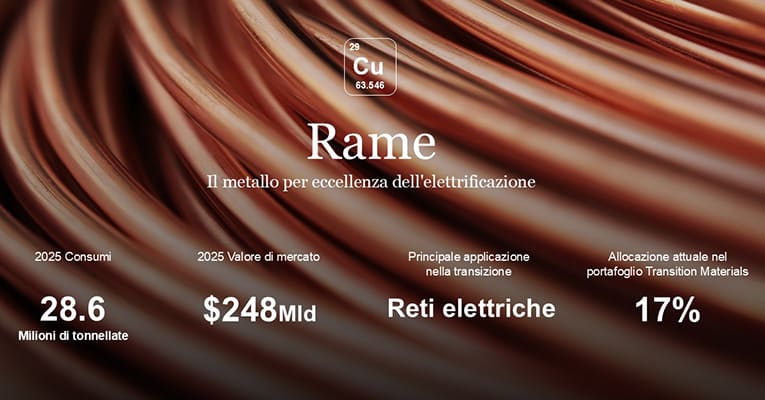
Il rame rappresenta uno degli esempi più evidenti di questa tendenza, grazie al ruolo centrale che svolge lungo l'intera catena dell'elettrificazione: dalla produzione e distribuzione di energia alla mobilità elettrica, fino alle infrastrutture digitali. La domanda è inoltre sostenuta dalla rapida diffusione dei sistemi di accumulo a batteria, essenziali per garantire la stabilità di reti elettriche sempre più alimentate da fonti rinnovabili.
FIG 3. Il rame: il metallo chiave dell'elettrificazione5
Implicazioni per i prezzi e prospettive d'investimento
La combinazione di questi fattori continua a creare un contesto favorevole per i materiali della transizione. La nostra visione positiva di lungo periodo si basa su tre elementi:
Vincoli strutturali dal lato dell'offerta, dovuti ai lunghi tempi necessari per sviluppare nuova capacità produttiva. Nel settore minerario, ad esempio, possono essere necessari più di dieci anni per portare un nuovo progetto in produzione, limitando la capacità dell'offerta di rispondere rapidamente alla crescita della domanda
L'aumento dei costi di produzione, legato alla crescente complessità dei processi autorizzativi e al rispetto dei requisiti normativi e ambientali
La crescente competizione tra le principali economie per l'accesso alle risorse strategiche, che contribuisce ad accrescere il valore e la rilevanza delle materie prime critiche.
Conclusioni: posizionarsi per il prossimo decennio
A nostro avviso, la strategia Transition Materials è allineata a una delle trasformazioni economiche più significative del nostro tempo. Negli ultimi tre anni, l'aumento della domanda di materie prime critiche, il crescente focus sulla sicurezza degli approvvigionamenti e la riconfigurazione delle catene globali del valore hanno ulteriormente rafforzato la nostra convinzione in questa opportunità d'investimento.
Combinando un'esposizione mirata a questi trend strutturali con la disciplina di un approccio d'investimento sistematico, la strategia mira a offrire accesso alle materie prime destinate a svolgere un ruolo centrale nell'economia del futuro. Attraverso l'investimento in contratti futures, l'attenzione è rivolta ai fondamentali di domanda e offerta che guidano questi mercati, piuttosto che ai risultati operativi delle singole società.
A tre anni dal lancio di Transition Materials, la nostra convinzione nel potenziale di lungo periodo delle materie prime della transizione si è ulteriormente rafforzata. Continuiamo a ritenere che questi materiali saranno tra i principali protagonisti delle trasformazioni economiche e industriali dei prossimi anni, e che la strategia rappresenti uno strumento efficace per coglierne le opportunità di investimento.
Per saperne di più sulla nostra strategia Transition Materials nel settore delle commodities clicca qui.
visualizza le fonti.
+
1 Le performance passate non costituiscono una garanzia di risultati futuri.
2 LOIM, dati a maggio 2024. A solo scopo illustrativo. Le performance passate non costituiscono una garanzia di risultati futuri.
3 LOIM. Strategy performance is based on a composite, from 1 May 2023 to 31 May 2026. Composite performance serves as indicative of the strategy. Past performance is not a guarantee of future results.
Transition Materials strategy
The benchmark is the Bloomberg Industrial Metals Subindex TR USD
Annual Composite and Benchmark Performance and Statistics
Period
Composite Return (%)
Benchmark (%)
Number of Portfolios
Internal Dispersion (%)
Composite Market Value
Total Firm Assets
Composite 3Y Volatility (%)
Benchmark 3Y Volatility (%)
YTD
14.46
15.40
1
194
62,376
12.41
15.82
2025
41.23
21.37
1
156
59,805
2024
3.50
3.54
1
124
53,880
May to Dec 2023
-4.20
-3.91
1
104
56,191
Annualized and Cumulative Returns and Key Statistics
Period
Annualized Returns (%)
Cumulative Returns (%)
Standard Deviation (%)
Sharpe Ratio
Tracking Error (%)
Information Ratio
Composite
Benchmark
Difference
Composite
Benchmark
Difference
Composite
Benchmark
Composite
Benchmark
1 Year
53.00
36.97
16.03
53.00
36.97
16.03
11.33
13.01
4.24
2.46
8.51
1.88
3 Years
19.88
15.00
4.88
72.27
52.07
20.20
12.41
15.82
1.15
0.59
9.11
0.54
5 Years
7 Years
10 Years
SI
16.54
11.36
5.17
60.29
39.35
20.94
13.17
16.54
0.83
0.35
9.01
0.57
Risk statistics are calculated with monthly composite and benchmark returns. Risk-free rate: compounded return of the FTSE 3-month Eurodeposit Index from inception to 31/08/23, then JPM 3-Month Cash Index from 01/09/23 in the relevant reporting currency. Composite and Benchmark 3 year volatility is, at each end-of-period, the Composite/Benchmark annualised volatility calculated on the prior 36 month data series. 3-year volatility is presented only if there are 36 or more monthly returns available. Internal Dispersion of individual portfolio returns are only present for calendar years when there are 5 or more portfolios in the composite for the full year. Sharpe Ratio: ratio of the composite returns in excess of the risk-free rate of relative returns Tracking Error: annualized standard deviation of monthly difference between composite and benchmark returns Information Ratio: ratio of the composites excess returns over the Tracking Error Gross returns were used to calculate all risk measures presented in the GIPS Composite Report. Composite and Benchmark Definition
The Transition Materials strategy is a rule-based long-only commodity strategy launched in May 2023. It provides exposure to a broad and diversified basket of commodities, with daily liquidity under a UCITS structure. The strategies objective is to focus on the supply/demand chain opportunities driven by a low carbon economy transition. In particular, the strategy is exposed to those commodity-heavy themes that are believed to be at the forefront of the transition, such as electrification, green mobility, materials substitution as well as recycled materials. It does not invest into commodities adversely exposed to the transition such as fossil energy. The investment universe mostly includes technology related metals and biobased materials, some of which are not part of traditional benchmarks. The composite leverage at year end: 2023 was 106.09% and 2024- 100.85%. The composite benchmark is an index from an external provider, the Bloomberg Industrial Metals Subindex Total Return. Base currency is USD. Management Fees and Other Information
All returns are presented gross of fund total expense ratio. The maximum TER for LOF - Transition Materials is 1.85% based on the PA share class (investment above CHF 1 million), with a management fee of 0.75%. Withholding tax on income is treated on a cash basis, whereby recoverable withholding tax, dependant on where a client is domiciled, is added back performance when occurring. Further information on calculation methodologies and composite management procedures is available upon request. GIPS Firm definition
'Lombard Odier Investment Managers (LOIM), the institutional asset management unit of Lombard Odier worldwide comprising all discretionary institutional mandates and all Lombard Odier public investment funds managed at the LOIM unit, but excluding Private Equity mandates and funds and the 1798 Hedge Fund family (as of 01.01.2013) as subject to a different management process. LOIM Exchange Traded Funds (ETF's) have been included since launch in April 2015. Firm Definition
The firm defintion was recently changed by mentioning the non-inclusion of the LOIM Private Equity portfolios and the exclusion of the 1798 Hedge Fund family as of January 1, 2013. This change was done for accuracy purposes and involves no change in the composite list or no material change in the assets under management figures. Claim of GIPS compliance
Lombard Odier Investment Manager claims compliance with the Global Investment Performance Standards (GIPS®) and has prepared and presented this report in compliance with the GIPS standards. Lombard Odier Investment Manager has been independently verified for the periods 31.12.1996 until 31.12.2023. The verification report(s) are available upon request. A complete list and descriptions of composite is available on request. A firm that claims compliance with the GIPS standards must establish policies and procedures for complying with all the applicable requirements of the GIPS standards. Verification provides assurance on whether the firm’s policies and procedures related to composite and pooled fund maintenance, as well as the calculation, presentation, and distribution of performance, have been designed in compliance with the GIPS standards and have been implemented on a firm wide basis. Verification does not provide assurance on the accuracy of any specific performance report. A complete list and descriptions of composites is available on request.
Significant Cash Flow Policy
The firm applied a Significant Cash Flow Policy for this composite until December 31, 2010 whereby portfolios were temporarily excluded from the composite on any significant cash flow occurrence. This practice was abandoned on January 1, 2011 and no portfolios were excluded for significant cash flow reasons as of that date. Benchmark Information
'The annual benchmark returns are calculated by multiplicative linking of the single-period benchmark returns. Any historic benchmark changes have been made to more closely reflect the composite strategy at a point in time. CFA Disclosure
GIPS® is a registered trademark of CFA Institute. CFA Institute does not endorse or promote this organization, nor does it warrant the accuracy or quality of the content contained herein.
4 Transition Materials è una strategia long-only sulle materie prime, basata su regole sistematiche, lanciata nel maggio 2023. La strategia offre esposizione a un paniere ampio e diversificato di materie prime, con liquidità giornaliera e struttura conforme alla normativa UCITS.
L'obiettivo è cogliere le opportunità lungo la catena della domanda e dell'offerta generate dalla transizione verso un'economia a basse emissioni di carbonio. In particolare, la strategia è esposta ai temi ad alta intensità di materie prime che riteniamo essere al centro di questa trasformazione, tra cui elettrificazione, mobilità sostenibile, sostituzione dei materiali e utilizzo di materiali riciclati. Non investe invece in materie prime che potrebbero essere penalizzate dalla transizione, come i combustibili fossili.
L'universo d'investimento comprende principalmente metalli legati all'innovazione tecnologica e materiali di origine biologica, alcuni dei quali non sono inclusi negli indici tradizionali.
La gestione del rischio viene effettuata a livello di portafoglio, mentre un team indipendente supervisiona i rischi d'investimento e operativi.
L'Indicatore Sintetico di Rischio (Summary Risk Indicator - SRI) fornisce una misura del livello di rischio del prodotto rispetto ad altri strumenti d'investimento. Indica la probabilità che il prodotto subisca perdite a causa delle oscillazioni dei mercati o dell'incapacità dell'emittente di adempiere ai propri obblighi di pagamento.
Il prodotto non offre alcuna protezione rispetto all'andamento futuro dei mercati; pertanto, l'investitore potrebbe perdere una parte o la totalità del capitale investito. Qualora l'emittente non fosse in grado di adempiere ai propri obblighi, l'investitore potrebbe subire la perdita totale dell'investimento.
I seguenti rischi possono essere particolarmente rilevanti, ma potrebbero non essere sempre pienamente riflessi dall'indicatore sintetico di rischio e potrebbero comportare ulteriori perdite.
Rischio di controparte: Qualora la strategia faccia affidamento su una garanzia prestata da terzi o ottenga una quota significativa della propria esposizione attraverso uno o più contratti con una controparte, esiste il rischio che quest'ultima non sia in grado di rispettare gli obblighi contrattuali assunti. Tale circostanza potrebbe comportare perdite finanziarie per la strategia.
Rischio di concentrazione: Nel caso in cui gli investimenti della strategia siano concentrati in uno specifico Paese, mercato, settore industriale, comparto o classe di attivo, la strategia potrebbe risultare maggiormente esposta agli effetti negativi derivanti da eventi che interessano tali aree.
Rischio di modello: I modelli utilizzati nel processo d'investimento possono essere definiti in modo non ottimale, implementati in modo errato o diventare meno efficaci in presenza di cambiamenti significativi nei mercati finanziari o nell'organizzazione. Ciò potrebbe influenzare negativamente la gestione del portafoglio e determinare perdite.
Non vi è alcuna garanzia di conseguire un rendimento né che non si verifichi una perdita significativa di capitale. Prima di assumere qualsiasi decisione d'investimento, si raccomanda di consultare l'ultima versione del Prospetto informativo, dello Statuto, dei Documenti contenenti le Informazioni Chiave (KID), nonché dell'ultima Relazione annuale e semestrale. Si invita inoltre a prendere visione dell'Allegato B "Risk Factors Annex" del Prospetto informativo.
5 LOIM; SunSirs; Grand View Research. Allocazione del portafoglio al 23 aprile 2026. Dati forniti a solo scopo illustrativo.
informazioni importanti.
Il presente documento è una Comunicazione di marketing destinata esclusivamente a investitori professionali.
Il presente documento è una Comunicazione aziendale destinata esclusivamente a investitori professionali e non è una comunicazione di marketing riguardante un fondo, un prodotto d’investimento o servizi d’investimento nel vostro paese. Il presente documento non mira a fornire consulenza d’investimento, contabile, professionale o legale.