When you visit our website, information may be stored or recovered on your device, mainly in the form of cookies. We use essential cookies to ensure the website works as it should, and statistical and marketing cookies for audience measurement and content customisation purposes. We rely on Google to store your consent choices and manage the activation of cookies accordingly. For more information on this, please also refer to the Google policy on Business Data Responsibility.
From the Cookie Management Centre, you can set your preferences with respect to the use of cookies: accept or reject certain categories, accept all, or reject all. For detailed information on all cookies used across these three categories, please refer to our Cookie Policy.
Please note that blocking certain cookies may affect your experience and the services offered.
Essential cookies Always active
Essential cookies help the website to work as it should by enabling necessary functionalities, such as navigating between pages and accessing secure areas. These cannot be disabled in our systems.
Statistical cookies
Statistical cookies help us understand how visitors interact with our site by collecting and communicating browsing information. They make it possible to identify the most and least visited pages and to improve the overall performance of the site.
Marketing cookies
Marketing cookies are used to display relevant advertising and measure the performance of campaigns. If you choose not to allow these cookies, you will continue to see ads, but they will be less relevant to your interests.
Choose the purposes for which we may use Google products to collect and use your data:
User storage: to technically permit advertising functionality.
User data for advertising: to optimise our advertising campaigns.
Ad customisation: to tailor advertising to your interests.
Three years on, the case for Transition Materials is even stronger
Laurent Joué
Head of Systematic Alternatives and Lead Portfolio Manager
Marc Pellaud, PhD
Lead Portfolio Manager
Thomas Höhne-Sparborth, PhD
Head of Sustainable Investing
Stephen Benson
Equity Analyst
key takeaways.
Transition materials are benefiting from powerful trends, including decarbonisation, electrification, AI-driven infrastructure growth and resource scarcity
Since its launch three years ago, LOIM’s Transition Materials strategy has combined targeted exposure to transition-related commodities with a systematic, risk-based investment framework
The long-term investment case is underpinned by increasing demand for and structural undersupply of commodities critical to the technology, energy and materials systems of the future.
The past three years have reinforced our conviction that commodities linked to the technology revolution and the transition to a low-carbon economy represent one of the most compelling long-term investment themes.
Both market performance and fundamental trends have confirmed the direction of travel we identified when launching our strategy in May 2023. The build-out of renewable-energy capacity, accelerating electrification and the rapid growth of AI-driven infrastructure all increase demand for critical materials. At the same time, supply remains constrained in many markets.
Since inception, LOIM's Transition Materials has demonstrated an ability to navigate these shifts. As one of the few strategies focused purely on transition commodities, with no oil and gas exposure, we believe we are well positioned to continue harnessing the opportunities.
sign up for our monthly newsletter.
Thank you for subscribing to our monthly newsletter!
There was an error registering your subscription. Please email loim-digital@lombardodier.com.
Validation of our approach
Transition Materials provides futures-based exposure to the range of commodities critical to the future global economy. The strategy has outperformed its benchmark since inception (see Figure 1)1, reflecting the value of this approach.
Our strategy also offers an inflation hedge and a diversified source of return – with low correlations to fixed income and global equities – while keeping a strong commodity footprint. Historical correlations have been approximately 0.1 to the Bloomberg Global Aggregate Treasuries Index, 0.3 to the MSCI World Index and 0.7 to the Bloomberg Commodity Index2.
The investment thesis gained significant traction in 2025. Markets increasingly recognised the implications of accelerating economic changes and the growing shortage of industrial materials.
2026 has provided short-term challenges. Evolving geopolitical developments, trade tensions and policy uncertainty have periodically weighed on markets and sparked volatility across transition-related assets.
Nonetheless, the strategy has remained resilient, supported by strong contributions from materials ranging from copper and aluminium to lithium and nickel, among others. Demand drivers including AI-related infrastructure needs and the continued expansion of battery production underscore the long-term investment case – which extends well beyond developments in oil and gas markets.
The results reflect an investment approach grounded in our conviction that resource demand is evolving across sectors. Three years ago, we repositioned our flagship commodities strategy to launch Transition Materials and capture the opportunities we believed would emerge.
A fundamental shift in our commodities investment philosophy
On 2 May 2023, only a few days before the World Health Organization declared the end of COVID 19 as a global health emergency, LOIM’s Commodity RP (Risk Premia) strategy was transformed into Transition Materials. In hindsight, the timing coincided with the emergence of a new geopolitical and economic regime, further reinforcing our views.
The foundations of the Transition Materials strategy were established well before 2023, however. LOIM had progressively incorporated analysis of long-term economic system changes across asset classes, including equities thematic strategies and multi-asset portfolios.
Strategic assets underpinning the transition
Commodities represented a natural extension of this thinking. The recognition that the transition to a low-carbon economy would require massive amounts of raw materials prompted a rethink of traditional commodity investment frameworks.
Rather than treating commodities as a cyclical asset class driven primarily by global growth, we began to view them as strategic assets underpinning structural transformation.
Through extensive collaboration with our Roadmap Research team, we gained insights into what would fuel future demand, in particular:
Electrification requires exponential increases in metals such as copper and aluminum
Renewable energy technologies rely on critical minerals, including lithium, cobalt and nickel
Grid expansion, storage solutions and digital infrastructure further amplify material intensity.
It became clear that structural supply constraints would likely coexist with sustained demand growth, creating favorable conditions for price appreciation in specific commodity segments.
This led us to narrow the focus of the investment universe to commodities directly linked to the energy transition and broader system changes. The new framework builds on our expertise in systematic, risk-based investing while introducing a fundamentally driven allocation.
Our approach: fundamental conviction, systematic implementation
The LOIM Transition Materials strategy combines two core pillars:
Fundamental selection of transition-relevant commodities
The eligible universe is restricted to commodity futures that play a critical role in decarbonisation, electrification and sustainable infrastructure development
Systematic risk-based portfolio construction
Within this universe, allocations are determined using our established quantitative framework, ensuring diversification, risk control and disciplined rebalancing
This hybrid approach preserves the discipline of systematic expertise while incorporating a forward-looking, thematic conviction based on deep research. It allows us to adjust exposures dynamically while remaining anchored to the structural drivers of the transition.
On geopolitics and resource security
Since the repositioning of the strategy, the commodity landscape has changed markedly. Cross-border tensions, most notably the Russia-Ukraine conflict and instability in the Middle East, have exposed vulnerabilities in global supply chains and heightened volatility across energy and raw-material markets.
At the same time, governments have increasingly prioritised energy and resource security alongside decarbonisation, driving greater economic fragmentation, resource nationalism and industrial-policy intervention. As a result, security of supply has become a key driver of commodity markets, investment flows and pricing dynamics.
Supply-side constraints are colliding with powerful demand drivers. Electrification, renewable-energy deployment, and investment in grids and transmission networks are pushing demand for key metals higher. AI is amplifying this trend, as data centers require large amounts of both energy and materials.
Demand for transition materials now extends across the broader economy, amplifying its scale and persistence.
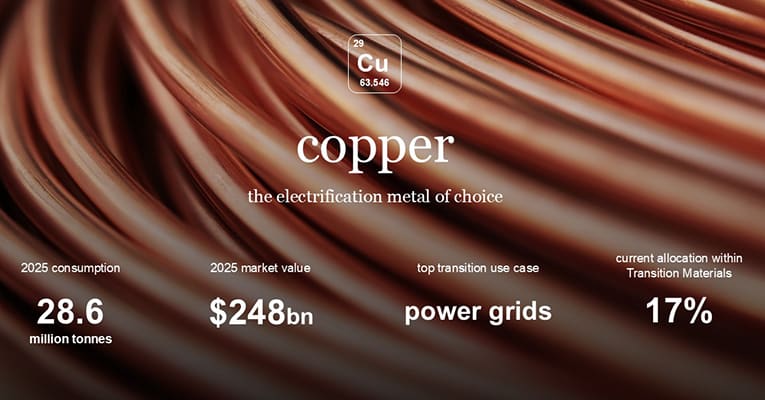
Copper exemplifies this dynamic, given its central role across all electrification pathways – from power generation and distribution to electric mobility and digital infrastructure. Demand is further supported by rapid deployment of battery storage systems required to stabilise increasingly renewables-heavy grids.
FIG 3. Copper: the electrification metal of choice5
Price implications and investment outlook
The combination of these forces creates a supportive environment for transition materials. Key factors underpinning our positive outlook include:
Limited short-term capacity to expand supply, due to long project lead times. For example, new mines can take more than a decade to develop, so supply growth remains slow even as demand accelerates
Rising production costs associated with the time and processes required to conform with environmental and regulatory requirements
Increasing competition for resources among major economies.
Conclusion: positioning for the next decade
In our view, the Transition Materials strategy is aligned with one of the most significant economic shifts of our time. The past three years have reinforced our conviction in this opportunity, amid rising demand for critical materials, resource nationalism and the reconfiguration of global supply chains.
By combining targeted exposure to these structural trends with the discipline of a systematic investment approach, the strategy seeks to provide investors with access to the materials underpinning the future economy. Through commodity futures, it focuses on the fundamental supply-demand dynamics shaping these markets, rather than the operational outcomes of individual companies.
Three years after the strategy's transformation, our conviction that transition materials will continue to shape global markets and long-term investment opportunities has strengthened – and we will continue to express this through our purpose-built strategy.
To learn more about our Transition Materials commodities strategy, please click here.
view sources.
+
1 Past performance is not a guarantee of future results.
2 LOIM, as at May 2024. For illustrative purposes only. Past performance is not a guarantee of future results.
3 LOIM. Strategy performance is based on a composite, from 1 May 2023 to 31 May 2026. Composite performance serves as indicative of the strategy. Past performance is not a guarantee of future results.
Transition Materials strategy
The benchmark is the Bloomberg Industrial Metals Subindex TR USD
Annual Composite and Benchmark Performance and Statistics
Period
Composite Return (%)
Benchmark (%)
Number of Portfolios
Internal Dispersion (%)
Composite Market Value
Total Firm Assets
Composite 3Y Volatility (%)
Benchmark 3Y Volatility (%)
YTD
14.46
15.40
1
194
62,376
12.41
15.82
2025
41.23
21.37
1
156
59,805
2024
3.50
3.54
1
124
53,880
May to Dec 2023
-4.20
-3.91
1
104
56,191
Annualized and Cumulative Returns and Key Statistics
Period
Annualized Returns (%)
Cumulative Returns (%)
Standard Deviation (%)
Sharpe Ratio
Tracking Error (%)
Information Ratio
Composite
Benchmark
Difference
Composite
Benchmark
Difference
Composite
Benchmark
Composite
Benchmark
1 Year
53.00
36.97
16.03
53.00
36.97
16.03
11.33
13.01
4.24
2.46
8.51
1.88
3 Years
19.88
15.00
4.88
72.27
52.07
20.20
12.41
15.82
1.15
0.59
9.11
0.54
5 Years
7 Years
10 Years
SI
16.54
11.36
5.17
60.29
39.35
20.94
13.17
16.54
0.83
0.35
9.01
0.57
Risk statistics are calculated with monthly composite and benchmark returns. Risk-free rate: compounded return of the FTSE 3-month Eurodeposit Index from inception to 31/08/23, then JPM 3-Month Cash Index from 01/09/23 in the relevant reporting currency. Composite and Benchmark 3 year volatility is, at each end-of-period, the Composite/Benchmark annualised volatility calculated on the prior 36 month data series. 3-year volatility is presented only if there are 36 or more monthly returns available. Internal Dispersion of individual portfolio returns are only present for calendar years when there are 5 or more portfolios in the composite for the full year. Sharpe Ratio: ratio of the composite returns in excess of the risk-free rate of relative returns Tracking Error: annualized standard deviation of monthly difference between composite and benchmark returns Information Ratio: ratio of the composites excess returns over the Tracking Error Gross returns were used to calculate all risk measures presented in the GIPS Composite Report. Composite and Benchmark Definition
The Transition Materials strategy is a rule-based long-only commodity strategy launched in May 2023. It provides exposure to a broad and diversified basket of commodities, with daily liquidity under a UCITS structure. The strategies objective is to focus on the supply/demand chain opportunities driven by a low carbon economy transition. In particular, the strategy is exposed to those commodity-heavy themes that are believed to be at the forefront of the transition, such as electrification, green mobility, materials substitution as well as recycled materials. It does not invest into commodities adversely exposed to the transition such as fossil energy. The investment universe mostly includes technology related metals and biobased materials, some of which are not part of traditional benchmarks. The composite leverage at year end: 2023 was 106.09% and 2024- 100.85%. The composite benchmark is an index from an external provider, the Bloomberg Industrial Metals Subindex Total Return. Base currency is USD. Management Fees and Other Information
All returns are presented gross of fund total expense ratio. The maximum TER for LOF - Transition Materials is 1.85% based on the PA share class (investment above CHF 1 million), with a management fee of 0.75%. Withholding tax on income is treated on a cash basis, whereby recoverable withholding tax, dependant on where a client is domiciled, is added back performance when occurring. Further information on calculation methodologies and composite management procedures is available upon request. GIPS Firm definition
'Lombard Odier Investment Managers (LOIM), the institutional asset management unit of Lombard Odier worldwide comprising all discretionary institutional mandates and all Lombard Odier public investment funds managed at the LOIM unit, but excluding Private Equity mandates and funds and the 1798 Hedge Fund family (as of 01.01.2013) as subject to a different management process. LOIM Exchange Traded Funds (ETF's) have been included since launch in April 2015. Firm Definition
The firm defintion was recently changed by mentioning the non-inclusion of the LOIM Private Equity portfolios and the exclusion of the 1798 Hedge Fund family as of January 1, 2013. This change was done for accuracy purposes and involves no change in the composite list or no material change in the assets under management figures. Claim of GIPS compliance
Lombard Odier Investment Manager claims compliance with the Global Investment Performance Standards (GIPS®) and has prepared and presented this report in compliance with the GIPS standards. Lombard Odier Investment Manager has been independently verified for the periods 31.12.1996 until 31.12.2023. The verification report(s) are available upon request. A complete list and descriptions of composite is available on request. A firm that claims compliance with the GIPS standards must establish policies and procedures for complying with all the applicable requirements of the GIPS standards. Verification provides assurance on whether the firm’s policies and procedures related to composite and pooled fund maintenance, as well as the calculation, presentation, and distribution of performance, have been designed in compliance with the GIPS standards and have been implemented on a firm wide basis. Verification does not provide assurance on the accuracy of any specific performance report. A complete list and descriptions of composites is available on request.
Significant Cash Flow Policy
The firm applied a Significant Cash Flow Policy for this composite until December 31, 2010 whereby portfolios were temporarily excluded from the composite on any significant cash flow occurrence. This practice was abandoned on January 1, 2011 and no portfolios were excluded for significant cash flow reasons as of that date. Benchmark Information
'The annual benchmark returns are calculated by multiplicative linking of the single-period benchmark returns. Any historic benchmark changes have been made to more closely reflect the composite strategy at a point in time. CFA Disclosure
GIPS® is a registered trademark of CFA Institute. CFA Institute does not endorse or promote this organization, nor does it warrant the accuracy or quality of the content contained herein.
4 Transition Materials is a rule-based long-only commodity strategy launched in May 2023. It provides exposure to a broad and diversified basket of commodities, with daily liquidity under a UCITS structure. The objective is to focus on the supply/demand chain opportunities driven by a low carbon economy transition. In particular, the strategy is exposed to those commodity-heavy themes that are believed to be at the forefront of the transition, such as electrification, green mobility, materials substitution as well as recycled materials. It does not invest into commodities adversely exposed to the transition such as fossil energy. The investment universe mostly includes technology related metals and biobased materials, some of which are not part of traditional benchmarks.
Risk management is performed at the portfolio level, while an independent team oversees investment and operational risks.
The summary risk indicator is a guide to the level of risk of this product compared to other products. It shows how likely it is that the product will lose money because of movements in the markets or because we are not able to pay you. This product does not include any protection from future market performance so you could lose some or all of your investment. If we are not able to pay you what is owed, you could lose your entire investment.
The following risks may be materially relevant but may not always be adequately captured by the synthetic risk indicator and may cause additional loss: Counterparty risk: When a strategy is backed by a guarantee from a third party, or where its investment exposure is obtained to a material degree through one or more contracts with a counterparty, there could be a material risk that the counterparty to the transactions will fail to honor its contractual obligations. This may result in a financial loss to the Strategy. Concentration risk: To the extent that the strategy's investments are concentrated in a particular country, market, industry, sector or asset class, the strategy may be susceptible to loss due to adverse occurrences affecting that country, market, industry, sector or asset class. Model Risk: Models may be misspecified, badly implemented or may become inoperative when significant changes take place in the financial markets or in the organization. Such a model could unduly influence portfolio management and expose to losses.
There can be no assurance that a return will be achieved or that a substantial loss of capital will not be incurred. Before taking any investment decision, please read the latest version of the prospectus, the articles of incorporation, the Key Information Documents (KIDs) and the latest annual report and semi-annual report. Please pay attention to the Appendix B “Risk Factors Annex” of the prospectus.
5 LOIM; SunSirs; GrandViewResearch. Portfolio allocation as of April 23, 2026. For illustrative purposes only.
important information.
For professional investors' use only
This document is a Corporate Communication for Professional Investors only and is not a marketing communication related to a fund, an investment product or investment services in your country. This document is not intended to provide investment, tax, accounting, professional or legal advice.