risks.

The following risks may be materially relevant but may not always be adequately captured by the summary risk indicator and may cause additional loss: Counterparty risk, Concentration risk and Model risk. Sustainability risks may lead to a significant deterioration in the financial profile, profitability or reputation of an underlying investment and may therefore have a significant impact on its market price or liquidity. The environmental, social, and governance (“ESG”) considerations discussed herein may affect an investment team’s decision to invest in certain companies or industries from time to time. Results may differ from portfolios that do not apply similar ESG considerations to their investment process.

glossary.

Transition Materials

Essential elements of the transition to a low carbon economy
 

The global economy is transitioning, transforming three systems: energy, land and oceans, as well as materials, accelerated by the pricing of carbon. As these changes unfold, we are seeing a fundamental re-wiring happening to our economies. In this transition, new technologies will unavoidably depend on key materials. 

Please note the Sub-Fund changed its name from LO Funds – Commodity Risk Premia on 2 May 2023.

Source: LOIM research analysis

In the shift to electrification, green mobility, material substitution, and recyclability, we foresee many dislocations in supply and demand.

For example, we anticipate upward price pressures (driven by both demand and scarcity) in copper, nickel, cobalt, aluminium, steel, and lumber among many other materials we constantly keep under review.

In our Transition Materials strategy, we actively seek exposure to these commodity-heavy themes at the forefront of the transition.

the market opportunity.

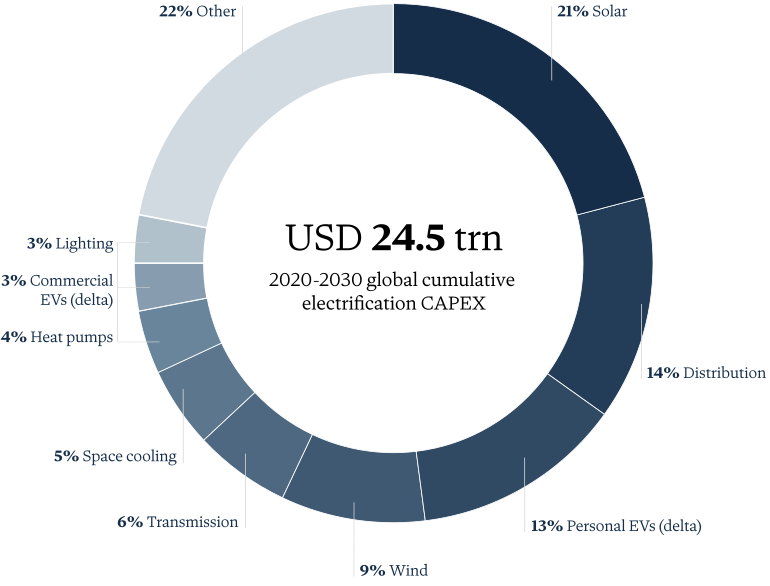
Past industrial revolutions have, historically, been a core driver of shifts in commodity markets. We estimate as much as USD 24.5 in trillion in capital expenditure may be deployed this decade in the energy transition alone.

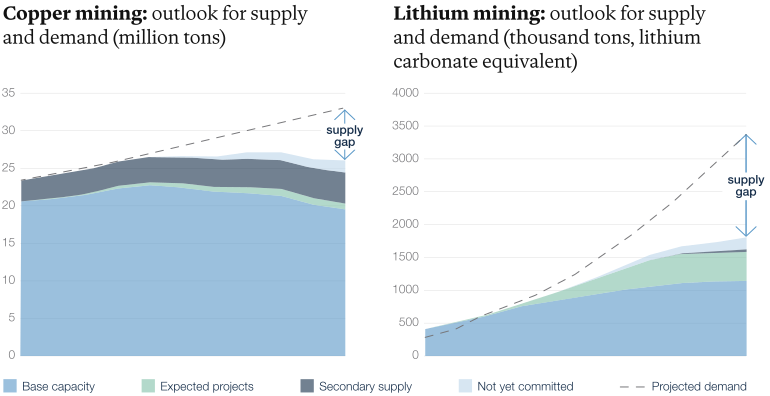
And just looking at supply and demand at lithium markets today, we see a clear supply gap.

transition demand.

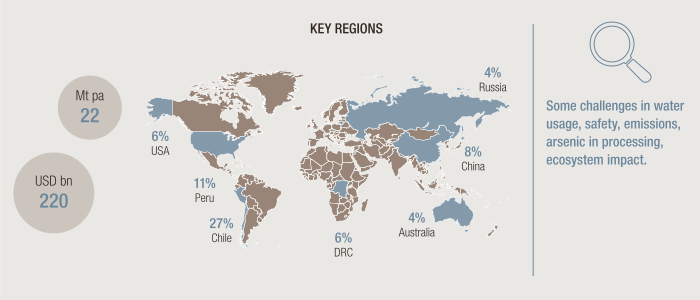
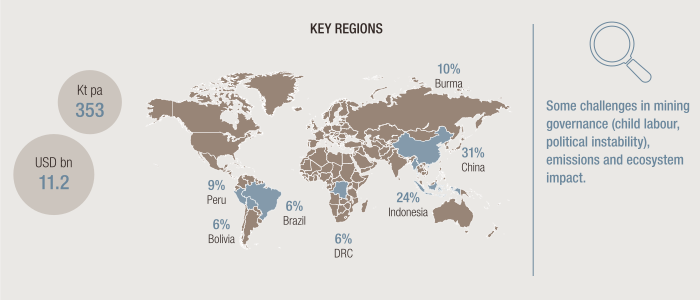
Commodities can be perceived as a sound investment in the transition. Most of the technologies needed heavily depend on specific materials such as copper, tin, zinc, steel, nickel or cobalt.

exploiting dislocations.

For example, solar photovoltaic (PV) plants, wind farms and electric vehicles (EVs) generally require more minerals to build than their fossil fuel-based counterparts. A typical electric car requires six times the mineral inputs of a conventional car and an onshore wind plant requires nine times more mineral resources than a gas-fired plant.

As transition technologies experience exponential growth, so too will the demand for the underlying commodities with which they are built. Ongoing proprietary research with our dedicated experts looks for dislocations in future supply and demand dynamics of those commodities. We look to exploit these within our portfolios.


Targeting commodities essential to the transition

our strategy.

Our Transition Materials strategy is designed to benefit from the long-term growth potential of commodity-heavy themes at the forefront of the transition.

  • Access to a broad and diversified basket of commodities identified as essential to the transition.
  • Exclusion of commodities negatively exposed to the transition, such as all energy fossils related commodities
  • Supply risk hedge. Direct exposure to upstream components (raw materials and supplies), different from manufacturers you can access with equities
  • Inflation hedge. Diversifying source of returns, low to negative correlation to traditional asset classes
  • Long-term potential upside driven by growth demand and sustainable supply chain risk
  • Fundamental investment framework integrating forward looking assessment of the supply / demand chain driven by the transition
  • Implemented through a rigorous systematic investment process based on risk diversification principles
  • Privileged market access with potential broader return opportunities relative to traditional Metals centric commodity benchmarks
  • 12+ years of experience in managing commodity strategies. Stable investment team, leveraging on the roadmaps research team insight as well as LOIM’s wider infrastructure
  • Benchmark - BCOM Industrial Metals Index and BCOM Global Commodity Index
  • UCITS funds with daily liquidity


Our investment process focusses on four key areas

Source: LOIM Research. For illustrative purposes only. There is no guarantee that a target objective will be reached (not an accurate indicator).

our themes explored.

investment team.

LOcom-AuthorsAM-Joue-2.png

Laurent Joué
Head of Systematic Alternatives, Lead Portfolio Manager

MarcPellaud-6687_press-coul-corp-backgrd-round.png

Marc Pellaud, PhD
Lead Portfolio Manager

LOcom_AuthorsAM-Hohne-Sparborth.png

Thomas Hohne-Sparborth, PhD
Head of Sustainability Research

insights.

get in touch.

Please enter your first name.

Please enter your last name.

Please enter your company name.

Please enter your job title.

Please enter a valid professional email address.

Please enter your message.


Your information will be used accordingly to our Privacy Statement

Lombard Odier Fleuron

important information.

This document is a Corporate Communication and is intended for Professional Investors only. This document is a Corporate Communication for Professional Investors only and is not a marketing communication related to a fund, an investment product or investment services in your country. This document is not intended to provide investment, tax, accounting, professional or legal advice. This document is issued by Lombard Odier Asset Management (Europe) Limited (hereinafter the “Company”).

More informations