When you visit our website, information may be stored or recovered on your device, mainly in the form of cookies. We use essential cookies to ensure the website works as it should, and statistical and marketing cookies for audience measurement and content customisation purposes. We rely on Google to store your consent choices and manage the activation of cookies accordingly. For more information on this, please also refer to the Google policy on Business Data Responsibility.
From the Cookie Management Centre, you can set your preferences with respect to the use of cookies: accept or reject certain categories, accept all, or reject all. For detailed information on all cookies used across these three categories, please refer to our Cookie Policy.
Please note that blocking certain cookies may affect your experience and the services offered.
Essential cookies Always active
Essential cookies help the website to work as it should by enabling necessary functionalities, such as navigating between pages and accessing secure areas. These cannot be disabled in our systems.
Statistical cookies
Statistical cookies help us understand how visitors interact with our site by collecting and communicating browsing information. They make it possible to identify the most and least visited pages and to improve the overall performance of the site.
Marketing cookies
Marketing cookies are used to display relevant advertising and measure the performance of campaigns. If you choose not to allow these cookies, you will continue to see ads, but they will be less relevant to your interests.
Choose the purposes for which we may use Google products to collect and use your data:
User storage: to technically permit advertising functionality.
User data for advertising: to optimise our advertising campaigns.
Ad customisation: to tailor advertising to your interests.
From Paris to profit: sustainability evolves into an economic strategy
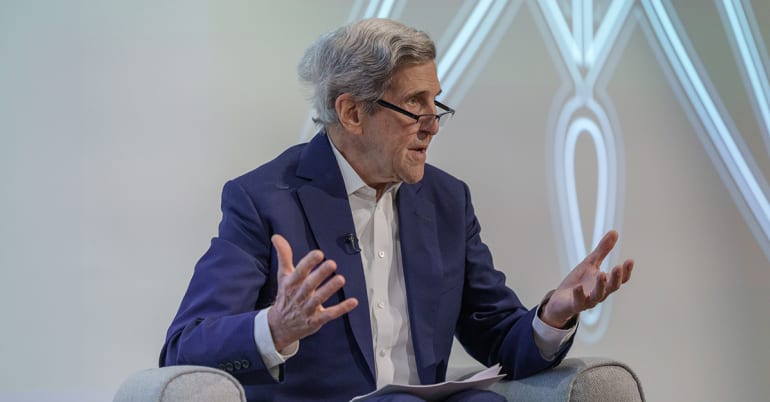
John Kerry, Co-Executive Chair, Galvanize, and 68th US Secretary of State, speaking at TIS 2026
key takeaways.
Increasingly, the sustainability transition is being driven by cost competitiveness, energy security and capital allocation, rather than policy or sentiment
LOIM’s annual Transition Investment Summit highlighted a system-wide transformation, with new demand drivers reshaping value creation
For investors, sustainability can be a framework for identifying long-term outperformance across sectors in a rapidly evolving global economy.
How should investors think about sustainability in 2026?
LOIM’s sixth-annual Transition Investment Summit (TIS) in London focused on the economic engines reshaping global energy, materials and social systems. These bring both challenges and tangible opportunities for returns.
watch highlights.
This year’s varied speakers included former US Secretary of State John Kerry, now the Co-Executive Chair of the global asset manager Galvanize; and Mathieu Flamini, Co-founder and CEO of GFBiochemicals1 and a former Arsenal football player.
Across the discussions, a palpable shift in perspective emerged: a decade on from the Paris Agreement, sustainability is no longer being framed as something driven by policy or values. Rather, it is a structural transformation powered by cost-competitiveness, technological innovation and capital allocation.
sign up for our monthly newsletter.
Thank you for subscribing to our monthly newsletter!
There was an error registering your subscription. Please email loim-digital@lombardodier.com.
Spurred by economics, not sentiment
The pace of change has become impossible to ignore, LOIM Co-Head Bettina Ducat said in her opening remarks. Energy inflation, supply chain disruption and shifting geopolitical dynamics have exposed deep structural fragilities in the global economy.
“This is not just an energy crisis. It is a stress test for an entire system – a call for a transition not in the future, but starting right now,” she said.
Sustainable investing provides a framework for navigating systemic disruption. That is why it remains a core conviction at LOIM, and why the firm’s sustainability strategies have continued to evolve in response to change, Ducat said.
Across the sessions, speakers returned to the theme of systemic stress and adaptation. Energy security emerged as a central issue, with the Iran conflict reinforcing the economic rationale for the sustainability transition. The narrative has shifted from away from purely environmental concerns to cost, efficiency and energy independence.
The market is proving its power. This transition is not driven by politics. It is driven by economic competition
John Kerry
Co-Executive Chair, Galvanize, and 68th US Secretary of State
Kerry highlighted how the dramatic decline in the cost of renewables, and clean energy investment now exceeding fossil fuels, reflects how investors are responding to economic signals. Capital is flowing to solutions that are cheaper, more efficient and more scalable.
“The market is proving its power,” Kerry said. “This transition is not driven by politics. It is driven by economic competition.”
Kerry highlighted small modular nuclear reactors and other examples of emerging technologies positioned to close the gap between accelerating energy demand and constrained supply.
Affordability concerns, policy gaps and the need for reliable supply mean that traditional energy investment will continue alongside transition solutions, said Alex Grant, Senior Vice President, UK Country Manager at Equinor2, another TIS speaker.
“The goal is not simply to reduce energy use at any cost, but to provide the energy society needs in increasingly decarbonised ways,” Grant said.
A system-wide transformation
Sustainability is fundamentally about economic outperformance, where more efficient, productive and scalable solutions displace legacy systems, according to Dr Thomas Hohne-Sparborth, Head of Sustainable Investing at LOIM. For portfolios, this calls for a cross-sector approach to the transition, rather than siloed thematic allocations.
“We go into every portion of the market and we ask ourselves, where do the pain points sit?” Hohne-Sparborth said. “We look for growing challenges that are solvable because they create an opportunity and a demand for disruption in addressable markets”.
He stressed the need to capture opportunities that align with better outcomes across the wider economy, at superior cost and efficiency. The sustainability agenda narrowed in recent years, neglecting the broader social dimensions originally embedded in frameworks such as the Sustainable Development Goals (SDGs), he said. This calls for a renewed appreciation of critical areas such as healthcare and financial inclusion.
Proving the business case
Jennifer Devine, Head of Wiltshire Pension Fund, spoke of how sustainability-related investing needs to be treated like any other investment – justified by clear financial returns and risk analysis. A successful transition creates better long-term financial outcomes, she said.
“We’re not here as philanthropists – we are here to make sure we’ve got the money to pay pensions in the future,” she said.
Greg Jackson, founder and CEO of Octopus Energy3, noted how the transition faces a critical inflection point. The challenge now is to deliver tangible economic benefits quickly enough to sustain public and political support.
Jackson pointed to Jeff Bezos’s philosophy at Amazon4 to underscore how the transition will ultimately succeed by lowering costs and improving outcomes for consumers, with the most successful business models focused on affordability and efficiency.
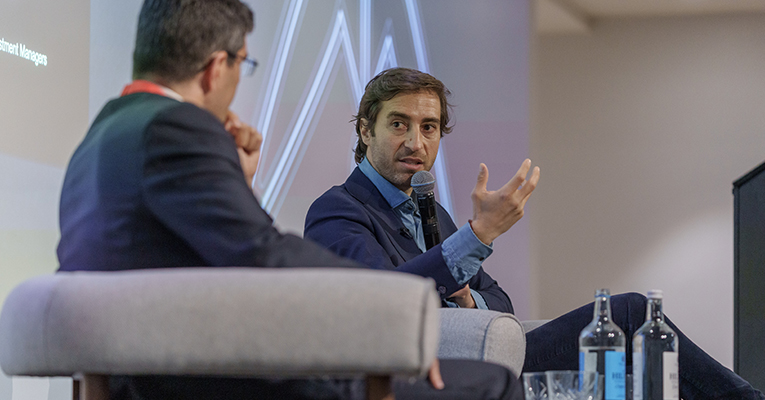
Flamini also emphasised how accelerating the transition requires making it relevant to consumers on a personal level. He highlighted how fossil-based chemicals remain deeply embedded across daily life – from personal care to food production – often with harmful effects. GFBiochemicals has developed technologies to convert agricultural waste into bio-based ingredients, enabling companies to shift away from fossil-based formulations, while reducing toxicity and improving sustainability. Mathieu Flamini, Co-founder and CEO of GFBiochemicals and former Premier League football player, speaking at TIS 2026
Flamini framed this shift as part of a broader industrial evolution, drawing parallels with solar energy and electric vehicles, where cost and performance improvements have driven widespread adoption.
Ultimately, raising awareness is key: by making the transition personal and demonstrating its benefits for health and quality of life, consumer behaviour can shift, helping to accelerate adoption across industries.
“People may not care about sustainability – but everyone cares about their health”, Flamini said.
An economic and industrial phenomenon
TIS 2026 underscored how this transition is complex, system-wide, and shaped by market forces, technological innovation and geopolitical realities. Emerging demand drivers show how it is being propelled not only by decarbonisation goals, but by the infrastructure requirements of the digital economy itself.
For investors, the message is clear: sustainability is no longer a niche allocation or a values-based choice. It is a core lens for understanding how returns will be created in the decades ahead.
A decade after the Paris Agreement, the sustainability transition has matured into a fundamentally economic and industrial phenomenon.
“Reality is not disproving the transition – it is confirming it”, Ducat said.
subscribe to investment insights and strategy updates
Preference Centre
view sources.
+
1 Any reference to a specific company or security does not constitute a recommendation to buy, sell, hold or directly invest in the company or securities.
2 Any reference to a specific company or security does not constitute a recommendation to buy, sell, hold or directly invest in the company or securities.
3 Any reference to a specific company or security does not constitute a recommendation to buy, sell, hold or directly invest in the company or securities.
4 Any reference to a specific company or security does not constitute a recommendation to buy, sell, hold or directly invest in the company or securities.
important information.
For professional investors' use only
This document is a Corporate Communication for Professional Investors only and is not a marketing communication related to a fund, an investment product or investment services in your country. This document is not intended to provide investment, tax, accounting, professional or legal advice.