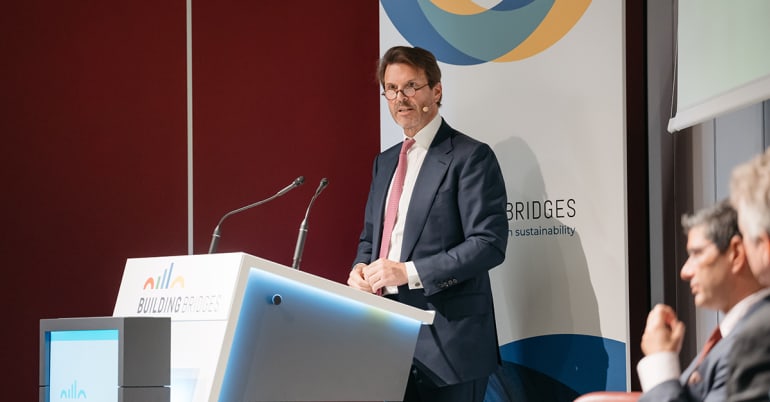
“Nature is, first and foremost, a productive asset,” said Hubert Keller, Senior Managing Partner at Lombard Odier, at Building Bridges 2026. “Nature powers a very significant portion of our economy.”
More than 55% of economic activity is highly or moderately dependent on nature. Some industries – like agriculture, construction, and food and beverages – rely directly on natural resources or ecosystem services like soils, water and insect pollination. Others, like consumer goods and autos, indirectly depend on the natural world for materials.
But in truth, practically all business activity relies on the natural world to some degree. Its resources are indispensable but not inexhaustible – and for too long this fact has been ignored to the detriment of nature and, over time, the economic activity it sustains.
Read also: Rethinking nature investment: capturing the opportunity in regeneration
Agricultural soils: degraded, unproductive and exposed
“The strategy that our economy has used for years, which is to exhaust a nature asset and move on to a new one, is simply no longer sustainable,” Keller said, in the opening remarks for a panel session focused on regenerative agriculture.
Major crop failures in recent years – from West African cocoa to Spanish olives, China rice and north-west American wheat and fruit – show that decades of intensive, industrial farming reliant on chemical fertilisers and pesticides have degraded agricultural land so they are significantly less productive and have little resilience to the shocks of extreme heat, drought, rainfall or flood that are part of climate change.
“Farming assets today are run-down. They have become much less productive,” Keller said. “Margins are squeezed and supply chains are becoming highly unstable.
“They are no longer resilient to extreme weather events – and we will witness more and more of these events,” he said.
Marc Palahí, Chief Nature Officer at Lombard Odier Investment Managers, provided two reasons why “food systems are at the centre of the climate and nature crises”.
First, soils are increasingly degraded due to extractive practices, which rely on synthetic inputs (pesticides and fertilisers) and large-scale monocultures. This reduces their resilience to extreme weather events, hotter summers and wetter winters resulting from climate change. With every degree of warming, the volume of water held in the atmosphere rises by 7%, leading to increased surface evaporation in summer and higher rainfall in winter as less precipitation falls as snow. “We have reduced the capacity of the soil to store water in a moment when it is most needed, which is why many farms are losing their productive capacity in the context of climate change,” Palahí said.
Second, long and complex supply chains typically see a range of intermediaries – from commodity aggregators or merchants to primary processors, ingredients suppliers, food manufacturers, distributors and then retailers – capture 80-90% of the final sale value1. This prevents cashflows to farms, where investment to increase resilience is essential.
“If we do want food security – and also if we do want sustainable consumer-facing businesses – we need to have a healthy, solid farming industry,” Keller said.
Video: Marc Palahí, Chief Nature Officer at Lombard Odier Investment Managers, explains how regenerative agriculture can underpin a food system that supports the environment, the economy and consumers.
watch via Building Bridges
|
The case for regenerative agriculture
Both “a miracle and a disaster”, the modern food system has produced enough calories to feed a booming global population but has become a leading cause of deforestation, biodiversity loss, climate change and soil degradation. Its products also contribute to health risk, with rising rates of cardiovascular disease and type 2 diabetes linked to consumption of ultra-processed foods. It also pays farmers an ever-shrinking share of the economic value created.
“It started a race to the bottom: to the lowest prices, the cheapest processed foods. And the co-morbidities and issues it has caused are being felt,” said Rob Appleby, Founder and CIO of Cibus Capital, an investment firm focused on regenerative agriculture and carbon credits.
A key part of solving these issues, he said, is regenerative agriculture: a farming approach that restores soils, biodiversity and ecosystems while sustaining agricultural productivity and improving the land’s capacity to store carbon and manage water. Or, simply, “agriculture” –because many regenerative practices were used for centuries before the rise of industrial farming, Appleby said.
Palahí agreed. In many ways, regenerative agriculture is a return to farming’s roots – by working with nature, not replacing it. It has three main principles:
| 1. |
Minimise soil disturbance through reduced tillage and maximise plant coverage of soils. This preserves soil structure that improves water infiltration and supports microbe, earthworm and mycorrhizal fungi populations for nutrient cycling. Soil organic carbon is retained and topsoil erosion is reduced |
| 2. |
Increase biodiversity above and below the soil surface. Methods include: crop rotation, intercropping and maintaining cover crops and crop residues, which provides a habitat and food for soil organisms, pollinators and insects; increasing plant and animal diversity by integrating trees, animals, flowers and hedgerow corridors; and in soils, supporting micro-organisms, fungi and earthworms |
| 3. |
Replace synthetic inputs with natural processes. Fertilisation is carried out by soil micro-organisms breaking down decomposing organic matter, nitrogen fixation by specific bacteria and mycorrhizal fungi that improve nutrient and water uptake by roots. Pest populations are suppressed by natural predators – insects, spiders, birds and other organisms, which are in turn supported diverse plants and hedgerows. Moreover, healthier soil in itself is more resistant to pests and disease. |
“There is evidence that regenerative farming practices can restore these assets – to leverage the power of nature to make they are more resilient, more productive and more economical to run,” Keller said. “So the business case for regenerative agriculture is strong, in addition to the massive environmental benefits.”
“There is evidence that regenerative farming practices can restore these assets – to leverage the power of nature to make they are more resilient, more productive and more economical to run”
The ‘missing middle’ in the switch from industrial to regenerative
Regenerative practices are conceptually straightforward but difficult to implement, Peter Fröhlich, a farmer and CEO of AgriPurpose, a cross-sector initiative which analyses the progress of farmlands towards regenerative outcomes, told the audience.
Rather than apply a formulaic approach in which synthetic inputs stimulate responses from the land, farmers harnessing natural processes must monitor how crops and their environment respond and then make adaptations carefully. “You are starting almost from scratch and seeing how nature responds,” he said.
“We measure the living system’s response: photosynthesis activity, soil cover and soil health. They are the big three,” Fröhlich said. “And we add one last dimension: efficiency. Because efficiency means sustainability.
“So if you have the living system’s response on photosynthesis activity, soil cover and soil health, and you’re producing efficiently, then you’re on the path.”

Hubert Keller, Marc Palahí, Robert Appleby, Peter Frölich und Katja Seidenschnur
If successful, these outcomes help deliver high-quality crops and sustain soil health for future crops. Cibus Capital has taken the journey. Appleby relayed how one of the firm’s strategies acquired a conventional olive grove2 managed with pesticides and fertilisers and then transitioned the asset so it used less water and put biochar from pyrolised olive pits into the soil, creating structure and promoting nutrient cycling and uptake. “It took risk because the existing farm managers, who were very good, asked who would take on the risk of it going wrong. And we said that we are,” he said.
Five years later, the organic, regenerative, 400-acre plot produced premium olive oil and was acquired by a Canadian pension fund. Upon exit, the farm sold for 2.6 times the purchase price, locking in a 20% IRR, Appleby said, and had become the largest organic olive oil producer globally. The commercial success, improved soil health and overall farm resilience were symbiotic.
However, while the necessity of regenerative agriculture, commercial incentives and environmental benefits are clear, the radical change in process and time required for land adaptation is daunting for farmers whose income depends on consistent farm-gate sales volumes. A key barrier is what Appleby called “the missing middle”. This is the combination of capital, networks and commercial offtake contracts that enable farmers who have begun the transition to complete the journey and achieve scale.
Offtakers and circular capital
Encouragingly, there is demand for regeneratively grown crops from big food.
Katja Seidenschnur, Global Head of Sustainability for Nutrition and Health at Nestlé, said the key reason why the food giant is attracted to regenerative farming can be captured in one word: resilience. This reflects the company’s focus on buying from farms that can protect long-term ingredient supply, restore soil and ecosystem health, and enhance farm profitability to support growers’ livelihoods and production.
Nestlé, a major global player in sectors including packaged coffee, dairy, prepared foods, confectionary and infant nutrition, is making a substantial effort to source more agricultural commodities from regenerative farms. At the end of last year, it had acquired 20.7% of its inputs from regenerative providers – including cereals, grains, cocoa, dairy, meat, poultry, eggs, vegetables and vegetable oils. It aims to increase this share to 50% by 2030. Speaking about the firm’s regenerative offtake, Seidenschnur said: “we don’t talk in anecdotes anymore”.
Beyond offtake contracts, the firm aims to assist farmers making the regenerative transition through measures that include:
- Technical assistance and training. Linking growers with agronomists and farmer networks to advance practices, ranging from cover cropping to agroforestry
- Funding. With CHF 1.2 bn over five years planned to accelerate regenerative farming across its supply chains
- Mitigating transition risk. Incentive programmes and longer term partnerships can be based on regenerative production.
The company reports that it engages a network of more than 500,000 farmers and 150,000 suppliers to advance regenerative farming practices. Working to increase its regenerative intake helps Nestlé sustain its commercial operations while contributing to its integrated climate and nature strategy, which includes a 1.5˚C pathway to become net zero by 2050.

Marc Palahí
Yet major corporates are not the only firms supporting the regenerative transition. Specialist operators provide a range of services – from certifying growers and building networks of farms to knowledge-sharing and aggregating supply to sell to food companies – are emerging as an important part of the value chain addressing the ‘missing middle’. There are nuances among their approaches, as shown by the following Illustrative examples3:
- Regenified: a US company expanding rapidly in Europe and other continents focused on certifying regenerative farmers and connecting them with food brands
- Soil Capital: a Belgium-based company providing agronomist support for farmers and analytical services for companies aiming to embed regenerative agriculture in their supply chains
- Wildfarmed: a UK food brand managing and supporting a collective of regenerative growers and aggregating supplies of flour, ingredients and products to supermarkets, bakeries, restaurants, breweries and other retailers
- Klim: a Berlin-based operator working with farmers to improve regenerative practices, and with food companies to investigate the health of the soils within their supply chains and the impacts on resilience and sustainability targets.
A key shift evident in the rise of regenerative-agriculture operators and offtakers is a focus on the sustainability of crops, farmers’ livelihoods and role as stewards of the land. This is a welcome departure from the extractive approach of prioritising farm-gate prices to the detriment of other considerations. If farmers can maintain yields at a lower cost per hectare, safeguard future supply and restore nature through regenerative practices, they would deliver a stronger foundation for food systems.
“For too long, farmers have been the villains: the ones creating externalities,” Appleby said. “But they are the ones who will be driving this transition; they are the stewards of the land. We need some heroes among them.”
Treat nature like bugs – with respect
“When I see a wasp inside my house, I trap it, take it outside and wish it well,” said Appleby, who studied zoology at Oxford University before pursuing an investment career.
There was seriousness in his comment: bees, hoverflies, moths, butterflies, beetles and wasps together pollinate a broad spectrum of plants. Bees are the most economically important, with hairy bodies highly adapted to carrying pollen across many fruit, vegetable, nut and oilseed crops. But other insects have specialised roles. Wasps, for instance, are the only effective pollinators for most fig species, with nearly every fig variation having a specific wasp partner. Without its partner insect, the corresponding fig species cannot reproduce.
This is one of many strands in the web of interdependencies that create nature’s complexity. Pull it, and others, through widespread habitat depletion and pesticide use, and the resilience formed by these relationships starts to unravel. Anyone with an interest in sustaining productive lands should therefore agree with Appleby: “the idea that we kill insects on an industrial scale is anathema to me”.
Food systems have depleted nature’s complexity, but they also have the power to regenerate it.
“We have simplified agricultural landscapes. We have replaced biodiversity with monocultures and we have replaced nature with synthetic inputs,” Palahí said.
“But we have the solution.”
subscribe to investment insights and strategy updates
Preference Centre
FAQs
By using techniques and practices that reduce synthetic chemical inputs and physical disturbance of soils, regenerative agriculture focuses on building soil health. Characteristics of healthy soils include: a natural structure supporting greater water absorption and populations of beneficial bacteria, earthworms and other organisms that drive nutrient cycling, and mycorrhizal fungi for greater nutrient and water uptake by crop roots.
Regenerative agriculture also aims to increase biodiversity, enhance natural carbon sinks, and in turn increasing the resilience of farms and value chains to extreme weather events that are becoming more common. By simultaneously mitigating climate change and helping farmlands adapt to its impacts, regenerative agriculture at scale has the potential to secure future crop yields at a lower cost per hectare and embed greater resilience in the food system.
The regenerative agriculture investment universe can be framed around three main opportunities:
- Land-backed strategies invest directly in farmland, permanent crops, grazing systems or forestry assets
- Integrated value-chain strategies invest across multiple stages of the food system, combining traceable regenerative production from farmer networks with processing, distribution and branded product sales
- Agricultural technology and enabling businesses invest in the infrastructure that enables regenerative agriculture, including: precision agriculture, robotics, biological inputs, genetics, advisory services and farm-management platforms, among others.
Investment capital is essential to scaling regenerative agriculture because it can help align incentives across the agri-food value chain. At this stage of market development, capital is particularly well suited to supporting platforms, operators and financing structures that bring together farmers, input providers, processors, food companies and retailers around shared regenerative outcomes. By helping coordinate stakeholders, absorb transition risks, and finance enabling infrastructure and services, capital can accelerate the adoption of regenerative practices while creating more resilient and sustainable supply chains.
Farmers typically undertake a three-to-five-year transition period to move away from monocultures to regenerative agriculture. They may initially face lower profitability, additional investments and operational risk before the benefits of regeneration fully emerge. In addition to agronomic support and finance, offtake agreements are key to overcome barriers for a successful transition.
The main scalability challenge is therefore not whether regenerative agriculture works, but whether farmers can successfully navigate the transition. Many studies show that regenerative systems can be profitable in the medium and long run, yet adoption remains constrained by short-term cash-flow pressures, knowledge gaps, tenancy arrangements and weak incentives – including lack of long-term offtake agreements or absence of rewarding systems for environmental outcomes. The security of a long-term offtake agreement eases this pressure by providing certainty of income once the first regenerative crops are harvested.