When you visit our website, information may be stored or recovered on your device, mainly in the form of cookies. We use essential cookies to ensure the website works as it should, and statistical and marketing cookies for audience measurement and content customisation purposes. We rely on Google to store your consent choices and manage the activation of cookies accordingly. For more information on this, please also refer to the Google policy on Business Data Responsibility.
From the Cookie Management Centre, you can set your preferences with respect to the use of cookies: accept or reject certain categories, accept all, or reject all. For detailed information on all cookies used across these three categories, please refer to our Cookie Policy.
Please note that blocking certain cookies may affect your experience and the services offered.
Essential cookies Always active
Essential cookies help the website to work as it should by enabling necessary functionalities, such as navigating between pages and accessing secure areas. These cannot be disabled in our systems.
Statistical cookies
Statistical cookies help us understand how visitors interact with our site by collecting and communicating browsing information. They make it possible to identify the most and least visited pages and to improve the overall performance of the site.
Marketing cookies
Marketing cookies are used to display relevant advertising and measure the performance of campaigns. If you choose not to allow these cookies, you will continue to see ads, but they will be less relevant to your interests.
Choose the purposes for which we may use Google products to collect and use your data:
User storage: to technically permit advertising functionality.
User data for advertising: to optimise our advertising campaigns.
Ad customisation: to tailor advertising to your interests.
Insights on the ground: meet companies driving the sustainability transition
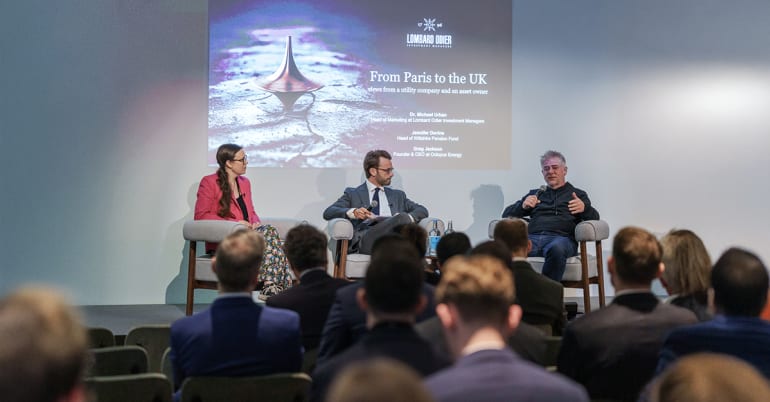
Jennifer Devine, Head of the Wiltshire Pension Fund; Dr Michael Urban, Head of Marketing at LOIM; and Greg Jackson, Founder and CEO of Octopus Energy
key takeaways.
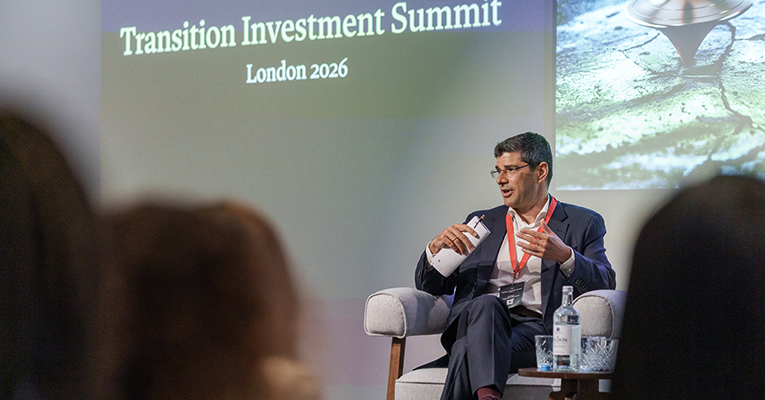
At LOIM’s 2026 Transition Investment Summit, we heard directly from companies turning sustainability into real-world business models
From green chemistry to regenerative agriculture, sustainable solutions must compete on cost, performance and scalability
The transition remains complex and uneven – execution and expertise will define the winners.
At LOIM’s annual Transition Investment Summit (TIS) in London, investors and industry leaders explored how deep structural changes in the global economy will drive the next wave of returns across markets.
Our first insight from the event unpacked the macroeconomic case for sustainability. We now turn to the realities on the ground, as companies at the heart of the transition confront the challenges stemming from scaling technologies and evolving business models, as well as how best to capture the upside.
watch highlights.
Building a smarter, cleaner energy system
A panel discussion entitled ‘From Paris to the UK’ underscored the forces reshaping the energy transition. Greg Jackson, Founder and CEO of Octopus Energy1, framed the company’s growth around a conscious decision to avoid activities harmful to the planet.
“Fossil fuels power the world we're in today, but I want to be building the world that follows it,” Jackson said. “It forces us to think creatively about how do you use the technology, the clean energy, to create better opportunities than you would in the old world”.
The transition is not just about adding capacity, but about rethinking how power is consumed and managed, he said. Greater access to real-time data and the expansion of dynamic pricing models could allow demand to shift more flexibly, reducing strain on power grids and lowering costs.
“We dramatically need more price signals and more transparency on the electricity system,” Jackson said. “Unless we allow the innovators, the entrepreneurs, those who represent consumption – unless we can see how the system is being used, how can we grab value for consumers and bring it to them?”
sign up for our monthly newsletter.
Thank you for subscribing to our monthly newsletter!
There was an error registering your subscription. Please email loim-digital@lombardodier.com.
Focusing on returns while supporting the transition
On the same panel, Jennifer Devine, Head of the Wiltshire Pension Fund, offered an asset owner’s view on how long-term capital is being deployed in support of the transition. Wiltshire’s Climate Opportunities Portfolio builds diversified exposure across asset classes while maintaining a clear focus on financial returns.
One of the challenges is the growing complexity of data, Devine said. While improved data availability strengthens analysis, it can also complicate decision-making and communication. Translating technical insights for pension members is becoming increasingly important.
“It is really challenging to learn how to navigate through that and make sure that we're being authentic, holding ourselves accountable, but also providing meaningful stories to the members that they really can understand”, she said.
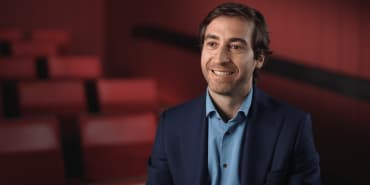
Mathieu Flamini, Co-founder and CEO of GFBiochemicals1, explored the future of green chemistry in a discussion with Marc Palahi, LOIM’s Chief Nature Officer. GFBiochemicals has developed patented bio-based solutions to help accelerate the defossilisation of the chemical industry.
Like the shift to solar power or electric vehicles, green chemistry represents the “industry of the future”, according to Flamini, who is also a former Premiere League football player. Success depends on competitive pricing, creative deal structures and strong industry relationships, which help reduce risk and enable more sustainable scaling.
The conversation also explored how geopolitical tensions and global competition are shaping Europe’s future in the chemical industry. Without faster, coordinated action between policymakers and industry, Europe risks falling behind in this area – just as it has in solar panels, batteries and EVs, Flamini said.
In a later discussion, Palahi focused on how nature underpins the economy, particularly food systems, and how pressure on natural systems is building. He sat down with Jose María Ortiz, Managing Partner at Nature Co, who talked about the need for scalable regenerative approaches.
'Marc Palahi, Chief Nature Officer at LOIM
Over the past 50 years, industrial agriculture simplified farming landscapes into monocultures while making supply chains increasingly complex. We now need to reverse that – simplifying value chains to improve transparency, increase efficiency, and ensure sustainable products remain affordable without relying on ‘green premiums’, Ortiz said.
TIS 2026 wrapped up with a focus on plastic circularity, exploring the challenges of transforming materials systems that are deeply embedded in the real economy. Unlike digital transitions, progress here involves physical processes, infrastructure and supply chains.
“Intellectual property is key. The advantage of being in the physical world is it's much harder for someone to get in once you have momentum.”
Remy Buser
CEO and Co-Founder of Bloom Biorenewables
Alexandre Ouimet-Storrs, Portfolio Manager at LOIM, discussed our Plastic Circularity strategy and some of the challenges involved in bringing solutions to scale.
He was joined by Remy Buser, CEO and Co-Founder of Bloom Biorenewables1, to discuss how companies are navigating this landscape. Bloom has successfully moved from laboratory research to industrial production, converting biomass waste into new materials.
A key strategy is to start with small-scale, high-value applications – demonstrating performance and generating revenue – before expanding into larger, more commoditised markets. Buser emphasised that much of the company’s competitive advantage lies in its accumulated expertise.
“Intellectual property is key,” he said. “The advantage of being in the physical world is it's much harder for someone to get in once you have momentum”.
He likened the process to cooking: even with the same recipe, outcomes depend on tacit knowledge developed over time. This “know-how” creates barriers to entry and supports long-term innovation.
For investors, this highlights the importance of patience and deep understanding. Scaling physical solutions takes time, but it also creates durable competitive advantages that are difficult to replicate.
A transition defined by execution
LOIM’s summit underscored how the sustainability transition is accelerating across energy, materials, nature and industrial processes. However, it is proving more complex than many anticipated. Businesses that can navigate those hurdles and scale effectively are emerging as leaders.
For investors, the opportunity lies in identifying those companies where sustainability is central to value creation. They are helping to shape the transition and build the foundations of an evolving global economy.
subscribe to investment insights and strategy updates
Preference Centre
view sources.
+
[1] Any reference to a specific company or security does not constitute a recommendation to buy, sell, hold or directly invest in the company or securities.
important information.
For professional investors' use only
This document is a Corporate Communication for Professional Investors only and is not a marketing communication related to a fund, an investment product or investment services in your country. This document is not intended to provide investment, tax, accounting, professional or legal advice.