When you visit our website, information may be stored or recovered on your device, mainly in the form of cookies. We use essential cookies to ensure the website works as it should, and statistical and marketing cookies for audience measurement and content customisation purposes. We rely on Google to store your consent choices and manage the activation of cookies accordingly. For more information on this, please also refer to the Google policy on Business Data Responsibility.
From the Cookie Management Centre, you can set your preferences with respect to the use of cookies: accept or reject certain categories, accept all, or reject all. For detailed information on all cookies used across these three categories, please refer to our Cookie Policy.
Please note that blocking certain cookies may affect your experience and the services offered.
Essential cookies Always active
Essential cookies help the website to work as it should by enabling necessary functionalities, such as navigating between pages and accessing secure areas. These cannot be disabled in our systems.
Statistical cookies
Statistical cookies help us understand how visitors interact with our site by collecting and communicating browsing information. They make it possible to identify the most and least visited pages and to improve the overall performance of the site.
Marketing cookies
Marketing cookies are used to display relevant advertising and measure the performance of campaigns. If you choose not to allow these cookies, you will continue to see ads, but they will be less relevant to your interests.
Choose the purposes for which we may use Google products to collect and use your data:
User storage: to technically permit advertising functionality.
User data for advertising: to optimise our advertising campaigns.
Ad customisation: to tailor advertising to your interests.
From transition to transformation: Greg Jackson on electrification, data and the UK’s energy future
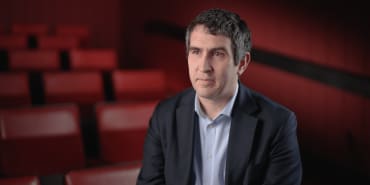
Greg Jackson, founder and CEO of Octopus Energy
key takeaways.
The UK's energy transition is entering a new phase, where the challenge is no longer renewables deployment but transforming the energy system
Energy companies are looking to the next wave of investment, which may be driven as much by data, flexibility and consumption as power generation itself.
At LOIM’s annual Transition Investment Summit, investors and industry leaders explored the next phase of the UK’s energy transition. As the focus shifts beyond deploying renewables towards a more electrified, flexible and data-driven energy system, the challenge is clear: how can the UK accelerate progress while delivering affordability, energy security and long-term growth?
In this video, Greg Jackson, Founder and CEO of Octopus Energy1, explains why the UK must stay the course and complete the move from transition to transformation. How are business models evolving for energy companies? And why are data and AI becoming increasingly critical to building a smarter, more efficient energy system that works for consumers?
What is the current state of the UK’s energy transition?
Renewables are actually the majority of electricity in our system. And I think that means that we have tipped from transition to transformation. It's important we do that though, because I think a lot of the policies and economic approaches are treating renewables as an add-on to the system, when really they are becoming the system.
I think the UK is kind of halfway across the road in its energy transition, which, by the way, is the worst place to stop. Right now there are, you know, some commentators, some members of the public, some politicians who are saying: “Hey, look, energy is too expensive”, and they're blaming renewables.
But if we look for inspiration from the people who've already crossed the road – like Norway, Spain – you can see that a world of greater electrification, which is more likely to come from renewables, not only means that prices are lower, but for example, today they're insulated from what's going on in the Middle East.
If we keep going and do it right, we can bring costs down of energy, enabling more economic growth, more affordability. I think that's got to be the secret of creating a popular and successful energy transition. So now is the time to double down our confidence, speed up, get across to the other side.
sign up for our monthly newsletter.
Thank you for subscribing to our monthly newsletter!
There was an error registering your subscription. Please email loim-digital@lombardodier.com.
How are energy businesses adapting to the transition?
I think that the business models for energy companies – not just energy suppliers, but throughout the chain – are going to increasingly involve thinking hard about how electricity is used.
Going forward, you're decoupling the immediate cost of the commodity from the immediate price, because through things like demand-response storage, the ability to charge electric vehicles at different times, the price that you charge customers is as much about the service and the management of that – or the special offers you bring them – as about the traditional kind of forecast commodity price.
If you connect the generation assets more directly to consumption, you can use the data from every wind turbine, every field full of solar panels, every rooftop installation to create tremendously accurate forecasts about the likely availability of electricity at a given time and location.
And if you're able to shift your consumption to those times, you reduce the total system costs. You need less balancing. You need less gas to fill the gaps, maybe fewer grid-scale batteries. So I think that connecting the incredibly rich and powerful data from every generating point to the understanding of every consumption point, can help us all create more value from the assets we have.
To do this, by the way, requires huge amounts of data. Octopus1 alone processes a million rows of data every three seconds to just manage a fleet of 300,000 electric vehicles. This is truly a world of AI and big data.
Increasingly, my conversations with institutional investors cover much more of a systems-thinking view. I think that's really helpful. And I should say our estimate is that there's going to be six times more investment in the consumption end of the energy transition than in the generation end.
subscribe to investment insights and strategy updates
Preference Centre
view sources.
+
[1] Any reference to a specific company or security does not constitute a recommendation to buy, sell, hold or directly invest in the company or securities. It should not be assumed that the recommendations made in the future will be profitable or will equal the performance of the securities discussed in this document. For illustrative purposes only. Important information on case studies.
The case studies provided in this document are for illustrative purposes only and do not purport to be recommendation of an investment in, or a comprehensive statement of all of the factors or considerations which may be relevant to an investment in, the referenced securities. The case studies have been selected to illustrate the investment process undertaken by the Manager in respect of a certain type of investment, but may not be representative of the Fund’s past or future portfolio of investments as a whole and it should be understood that the case studies of themselves will not be sufficient to give a clear and balanced view of the investment process undertaken by the Manager or of the composition of the investment portfolio of the Fund now or in the future.
important information.
For professional investors use only
This document is a Corporate Communication for Professional Investors only and is not a marketing communication related to a fund, an investment product or investment services in your country. This document is not intended to provide investment, tax, accounting, professional or legal advice.