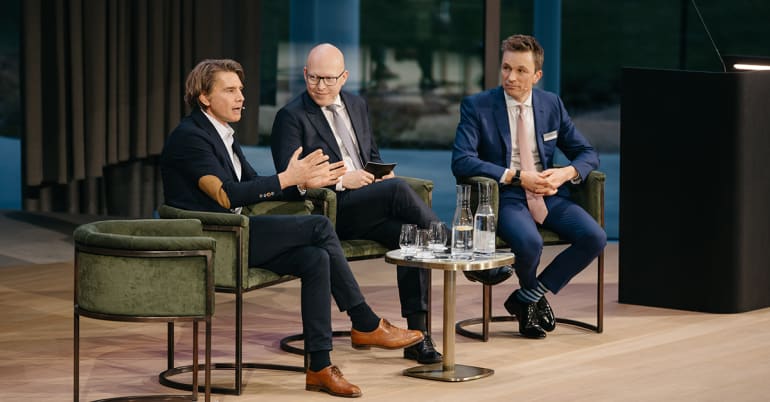
The inaugural edition of Rethink Investments, held on 20 January 2026 at Lombard Odier’s new global headquarters in Geneva, sought to create a moment of reflection and exchange focused on a simple and powerful conviction: stability cannot be decreed. It must be built, anticipated and, very often, negotiated.
At Lombard Odier Investment Managers (LOIM), our chief goal is to help institutional and wholesale clients navigate complexity, capture opportunity and achieve enduring success. We see parallels between the art of negotiation, investment decision-making under pressure and sustaining the long-term trust of clients – especially during periods of acute market uncertainty.
In his opening remarks, Jean Pascal Porcherot, Managing Partner of Lombard Odier and Co-Head of LOIM, reminded the audience that the Group’s global headquarters profoundly embodies the identity of the firm. “A Maison that this year celebrates its 230th anniversary, with solid Swiss roots but firmly open to the world. A House whose longevity rests on its ability to question, to read the world, to anticipate change and to adapt.” He emphasised the spirit that guides Lombard Odier: “‘Rethink’ is more than a word; it is a philosophy. It is a way of approaching the world, of innovating, of finding solutions where others see constraints.”
For highlights of Rethink Investments 2026, please watch the video below.
To explore the art of negotiation in all its complexity, the event was structured around four panel sessions, which explored:
- The fundamental mechanics of negotiation – with Yves Rossier, former Swiss Ambassador to Russia, and Alexandre Ouimet-Storrs, Investment Director of the LOIM Plastic Circularity private equity strategy
- The decisive role of trust – with perspectives from Sameh Abadir, Professor of Leadership and Negotiation at the IMD Business School, and Aurèle Storno, CIO of Multi Asset at LOIM
- Negotiation under pressure – featuring Bernard Thelier, former Top Negotiator in the Crisis Management Division of the French National Gendarmerie (GIGN) and Yannik Zufferey, CIO of Core Business at LOIM
- The concrete implications for investors in an increasingly unbalanced world – with Zufferey, Storno and Ouimet-Storrs.
In the context of rapidly shifting geopolitical power relations, reconfigured value chains and increasingly uneven economic cycles, a central question emerged: how can we negotiate for concrete outcomes in a world out of balance, while identifying the levers for action and the opportunities arising from uncertainty?
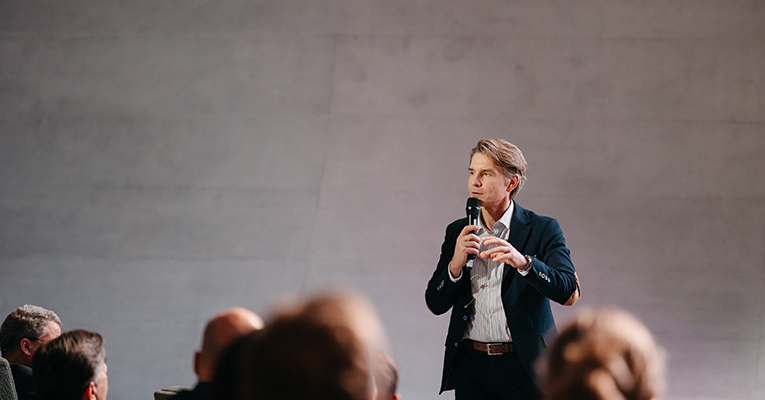
Bernard Thellier, former Top Negotiator in the Crisis Management Division of the French National Gendarmerie.
Read also: Building Bridges 2025: spotlight on sustainable private markets
Negotiation and mediation: two complementary logics
Following Jean-Pascal Porcherot’s opening address, the first panel laid the foundations for exploring the event’s central theme by explaining that before any negotiation takes place, the type of discussion at hand must be understood.
For Yves Rossier, there are three types of negotiation. “One-off negotiation; negotiation where you are a stakeholder; and mediation, where you carry the discussion between two parties who can no longer speak to each other,” he said.
Rossier unpacked a crucial element of the latter: “In mediation, the parties want to escape a situation that has become untenable. They do not trust each other. They have expressed and unexpressed fears. Without a minimum [level] of trust, no negotiation can succeed.”
This diplomatic reality echoes in private equity, as Alexandre Ouimet-Storrs noted: “We invest as a minority shareholder. You have the founders and other investors. When agreement breaks down, mediation and arbitration clauses are essential. They defuse situations,” he said. “It’s a tool that protects the company and our clients.”
What signals indicate that a negotiation has truly begun? The panelists’ answer was crystal clear: negotiation starts when the status quo becomes untenable. “The trigger is a situation which the parties believe must change,” explained Rossier. In some cases, time is of the essence: “I once had to extract three young girls from a Muslim republic in Russia. There, time is decisive,” he said. “But in most negotiations, it’s not the hours that matter, it’s the conditions.”
This rule applies in private markets too, Ouimet-Storrs said. “Sometimes we disagree on valuation. So we stop. And we say we’ll reopen negotiations when conditions change,” he said. “Sometimes you need to ease off, let the market do its work, and return later.”
But it’s important to not allow the process to drag on. “If negotiation goes on too long, stakeholders get tired and start conceding important points,” Ouimet-Storrs said.
Both speakers converged on two essential elements: genuine consideration of the other party’s interests and the importance of reputation must not be overlooked. To negotiate is to initiate or deepen a human relationship, after all. Rossier contrasted two approaches: “Some think they must hate the other party. I believe, on the contrary, that genuine consideration is fundamental. If it is feigned or insincere, negotiation does not work.”
Ouimet-Storrs agreed: “If I cannot have a pleasant dinner with the person opposite me, I won’t negotiate with them,” he said. Respectful, clear, patient and intelligent conduct – in addition to emotional intelligence, problem-solving skills and genuine consideration – will instil trust over time, creating a robust yet fragile platform to carry discussions. “Reputation takes years to build and seconds to lose.”
This bridged to the next panel, dedicated to trust – a transversal theme underpinning all forms of negotiation.
Read also: Harnessing private markets to invest in structural shifts: LOIM’s approach
Trust in the service of negotiation
Trust forms the foundation of all productive relationships, whether diplomatic, managerial or financial – and the second panel explored its strengths and vulnerabilities.
With his direct style, Sameh Abadir stated: “People commit to someone for two reasons: either for their kindness or for their intelligence.” For Abadir, trust arises from the balance between bold decision-making and authentic care for people. “Competence reassures, character connects. You need both.”
Behavioural biases
Aurèle Storno, CIO of Multi Asset at LOIM, emphasised how biases influence investor decision-making. “We are all shaped by our background, values and experiences. Under stress, some see a problem; others see an opportunity,” he said, stressing that the excesses of such biases can be controlled through disciplined processes – and this is inseparable from establishing and maintaining trust.
Trust requires confidence in the investment process itself, and the team’s commitment to adhering to it. This prevents overreactions to short-term noise and anchors decisions in a proven methodology. “Without a framework, our biases catch up with us,” Storno said. “We hold on to our losses and take profits too quickly. Process is there to contain these biases.”
Trust in team members – who help challenge assumptions, illuminate blind spots and prevent collective biases from taking hold – is also essential. So is trust in one’s own ability to recognise and manage biases. This combination of self-awareness, collegial debate and disciplined process is what ultimately “brings the team back to coherence” and provides clarity amid uncertainty.
Acceptability, weak signals and communication
Abadir also highlighted how leaders can cultivate trust by managing communications and knowing when to negotiate.
He distinguished between front-stage communication, designed to reassure, and back-stage communication, where the most difficult decisions are made. The front stage is what a leader projects broadly – how a decision is presented to maintain cohesion, provide direction and avoid panic. The back stage is where real debate occurs, where doubts are voiced, trade-offs built, disagreements confronted and deals made.
Understanding this distinction, and knowing how to navigate between the two, is essential to avoiding misunderstandings during crises, preserving trust and ensuring consistent communication to teams, partners and clients. For long-term investors, this clarity is even more critical. The ability to maintain confidence, communicate coherently and uphold a stable decision-making framework directly influences the durability of their investment convictions and the relationships they rely on to execute them.
This analysis transitioned to the topic of third panel – because trust and a clear framework become integral to managing high-pressure situations.
You don’t act because you’re ready. You become ready by acting.”
Negotiation under pressure
The third panel addressed negotiation at moments of peak uncertainty. Bernard Thelier and Yannik Zufferey showed that pressure is not an exception but a common factor influencing decision-making. So are the emotions it triggers. As a former GIGN negotiator, Thelier observed: “Keeping control of your emotions isn’t a luxury – it’s a necessity. It allows you to stay on course when others panic.”
He shared the striking image of a ritual carried out by assault teams preparing to execute a mission. Each member places a hand on the shoulder of the person in front to confirm their readiness, concentration and commitment. The first in line does not need to turn around; they know the whole team is aligned, grounded in the present. The team can then proceed – clear-headed and committed under maximum pressure.
Read also: Power plays – geopolitics, energy security and infrastructure opportunity
The real danger is uncertainty
Thelier distinguishes between risk and uncertainty. “Risk can be reduced through training or wearing a bulletproof vest. But uncertainty cannot be eliminated. It’s what makes a crisis dangerous.” His experiences have taught him a key lesson in managing uncertainty: “Reflection fuels fear; action turns it into adrenaline. You don’t act because you’re ready. You become ready by acting.”
For Zufferey, investors must also grapple with risk and uncertainty. “When a crisis hits, you cannot control uncertainty. What protects you is the framework – the investment process,” and it must be applied. He identified three successive phases that are common to crises:
- Crisis of confidence – marked by a rapid deterioration in sentiment and falling asset prices
- Liquidity crunch – typical of the most severe episodes, when many investors try to sell simultaneously, offloading their most liquid assets first. “But soon there are no buyers left,” further amplifying downward market moves, Zufferey said
- Opportunities emerge – often following decisive external intervention, such as central bank or government stimulus to improve sentiment and liquidity conditions.
Timely action is essential at each of these brief yet decisive inflection points. This underscores how preparation, discipline and reactivity shape an investor’s ability to turn crisis into an attractive entry point.
But how should an investor approach an environment where uncertainty appears permanent? This was the focus of the fourth panel.
Investing in an unbalanced world
The fourth panel brought together Yannik Zufferey, Aurèle Storno and Alexandre Ouimet-Storrs, to link the art of negotiation with investment decisions and portfolio construction.
For Zufferey, the global economy is undergoing profound restructuring in an increasingly fragmented world, shaped by the rise of AI, re-industrialisation, geopolitical tensions and diverging monetary policies. “We must accept that uncertainty is now part of the landscape. The point is not to eliminate it, but to have a framework for making decisions.” Instead of trying to make predictions in an environment that has become too volatile, investors should place faith in a robust analytical process to continue moving forward.
Read also: Rethink, relearn, respond: portfolio stability in an unstable world
Storno noted that AI represents a regime shift with inherent uncertainty. “This isn’t a classic cycle. It is a massive investment wave, like electricity or the internet. It creates opportunities, but also risks of overvaluation,” he said. In response, the importance of prudent governance, diversification and discipline against biases were key for investors, he stressed.
He identified several market segments to watch more closely in 2026, noting that: “Convertibles have a convexity component that can be useful in different scenarios,” such as corrections, while also preserving the ability to participate in a recovery. Commodities could also prove valuable in times of stress, such as the recent bouts of volatility: “Short-term commodities provide a rather interesting source of diversification.”
Ouimet-Storrs emphasised that relationships are fundamental to success in private markets. “In private equity, value creation depends on the quality of relationships between investors, founders and management. Clauses matter – but trust matters even more.” He added: “Someone who feels wronged in a negotiation today becomes a source of problems tomorrow. A true win-win outcome is indispensable – and that’s not a cliché.”
Uncertainty is now part of the landscape. The point is not to eliminate it, but to have a framework for making decisions
Trust is golden
Investors in the audience then took the opportunity to participate in an open-floor Q&A session. Delegates focused on how to rebuild trust after it had been damaged and structure communication in times of stress. Our speakers emphasised that in such moments, coherence and timing play roles that are as decisive as the message itself.
An ambiguous question about “gold” stood out. Rather than address the asset class, the speakers interpreted it as a metaphor for psychological refuge in a negotiation. This reframing brought the discussion back to fundamentals: when conditions become uncertain, “gold” is not a metal but something equally precious: the anchor of a relationship. It is the baseline trust needed to keep moving forward even when positions diverge.
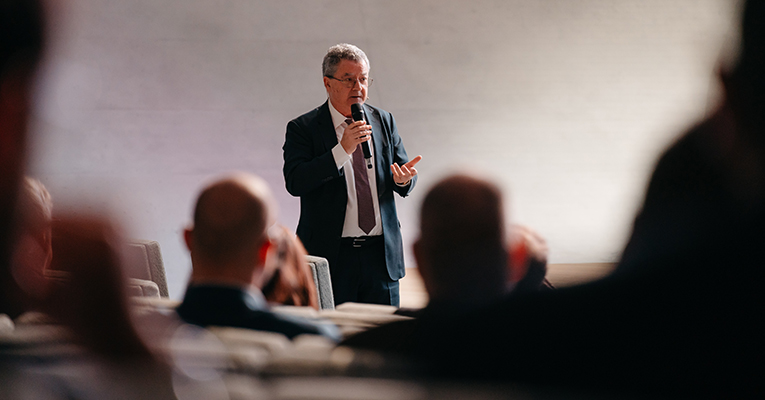
Yves Rossier, former Swiss Ambassador to Russia
Read also: Thirsty work: why cutting-edge AI needs water cooling
Thinking differently to support clients through uncertainty
Closing the event, Bettina Ducat, Co-Head of LOIM, reaffirmed the ambition of this inaugural edition of Rethink Investments: to step back, create a space to leverage collective expertise for the goal of helping investors achieve long-term objectives, irrespective of market conditions.
“Stability cannot be decreed. It must be built, anticipated and negotiated,” Ducat said. Emphasising the importance of the human dimension in high-stakes discussions, she added: “What we heard today shows just how essential trust, clarity and listening are for navigating periods of tension.” For LOIM, “Our role is to continue providing clarity amid complexity and to help our clients make informed decisions in a rapidly changing world.”
By bringing together elite negotiators, diplomats, leadership experts and investors, the event demonstrated a defining characteristic of Lombard Odier: to rethink everything in forging the perspectives, convictions and decisions that achieve successful client outcomes. In a world gripped by uncertainty, the ability to analyse, anticipate, negotiate and act with purpose and discipline enables us to invest – beyond convention, with conviction – to meet clients’ needs.
subscribe to investment insights and strategy updates
Preference Centre