At a total value of more than USD 11 trillion1, private markets are only a fraction of the size of public markets. Yet, increasingly, they are seen as potentially offering more attractive sustainable investment opportunities and as outperforming public markets when it comes to low-carbon investment solutions. Private markets are also growing exponentially faster than public markets, enable a longer-term perspective and make it easier to invest in early-stage sustainability innovations.
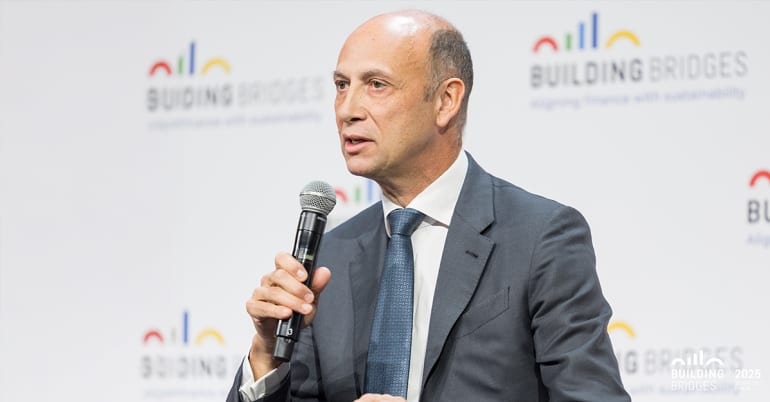
That was the message for investors at the centrepiece summit at Building Bridges 2025 in Geneva, as Jean-Pascal Porcherot, Managing Partner at Lombard Odier and Co-Head of Lombard Odier Investment Managers, joined leading voices in the world of sustainable finance for a panel entitled ‘Private Markets: Decisive Capital for a Decisive Decade’.
Together, Jean-Pascal Porcherot; Marion Leslie, Head of Financial Information at SIX Group; Emmanuel Jaclot, Executive Vice-President and Head of Infrastructure and Sustainability at La Caisse; Rupert Robinson, Managing Director at Gresham House; and Sophie Gioanni, Head of Investor Relations at ILX Management, explored the growing importance of private markets in sustainable investing, and emphasised what quickly became a key theme of the summit – sustainable finance must, first and most importantly, deliver financial returns.
Transition unfolds through system changes
Jean-Pascal Porcherot began by outlining the deep changes taking place across our economy. “We believe the environmental transition will unfold through three main system changes – namely, energy, nature and materials,” he said.
“When we look at energy, we need to electrify the economy. We believe 70% of our energy needs will be fulfilled by electricity by 2050, and that 80% of that electricity will come from renewable sources2. When we look at nature – which is about how we feed the population – we need to move to regenerative agriculture practices and resilient value chains. And in materials, we need to move away from primary materials extraction and towards circular business models – of course, hard-to-abate sectors such as steel, aluminium and plastic will be impacted.”
He continued, “In our energy system, renewables and infrastructure have attracted a lot of capital. But there is a financing gap when it comes to nature and materials. This is where private markets can play a critical role. But achieving positive impact alone won’t be enough to scale up the solutions we need.” For investors, financial returns are a key aspect, he said.
“We believe the environmental transition will unfold through three main system changes – namely, energy, nature and materials.” – Jean-Pascal Porcherot, Managing Partner, Lombard Odier
Nature – “a huge asset class”
“At Lombard Odier, we believe that nature is going to be a huge asset class,” Jean-Pascal Porcherot continued. “It’s important to note that nature absorbs roughly half of the CO₂ released by human activities each year, equivalent to around 10–12 gigatonnes3, but that’s not sustainable if we keep damaging our ecosystems and depleting biodiversity.”
Speaking on behalf of Gresham House, Rupert Robinson picked up on this theme. “From our perspective, nature is an evolving asset class,” he began. “We need to put ourselves in the shoes of asset allocators. Pension funds, for instance, have fiduciary responsibilities,” such as needing to deliver financial returns.
Giving a real-world example of how this can be achieved, he said, “We’ve created an institutional biodiversity net gain investment proposition, born out of UK legislation. We had to work out what is the appropriate return for investors. The question is, can you take an asset class, structure it over a long duration, with the right return characteristics, and then deliver that for clients in a packaged solution.”
our expertise.

nature: upending extractive approaches
learn morenature: inelastic food demand underpins real-asset resilience
learn more Emerging markets and the global south
As nature-based investing evolves, many opportunities are likely to be found in the global south, Jean-Pascal Porcherot explained. “When you develop an institutional offering you face a lot of hurdles, so you have to think outside the box,” he said. “We are focussing on coffee. We aim to buy land in the global south to transition the coffee production towards regenerative practises.”
“But a lot of institutional investors remain cautious about EM (emerging market) investing, so you need to mitigate risks,” he continued. “This can be about whether you’re leasing or buying the land; it can be working with MIGA (Multilateral Investment Guarantee Agency), which offers insurance within the World Bank to cover expropriation risks. We aim to work with corporate off-takers to secure revenues – this helps you reduce the IRR (internal rate of return) that investors are going to need to be comfortable. You need to engage with investors early on.”
Sophie Gioanni echoed the importance of making investors aware of the difference between the “perceived risk versus the actual risk,” of investing in emerging markets. Investors often have a fear of “political instability, currency fluctuation or a lack of ability to enforce legal documents,” she said. However, “with MDB (multi-lateral development bank) structured loans, for example, what we’ve seen is that default and recovery rates are attractive.”
On-the-ground collaboration
In keeping with the central theme of Building Bridges, which is to foster collaboration across sectors and geographies, Sophie Gioanni explained that investing in the global south requires strong local partnerships. “It’s difficult for a pension fund in Canada, for example, to find reliable opportunities as they don’t have boots on the ground. You need to know the local governments. There are lots of opportunities – such as agri-businesses, solar parks, investing through local financial institutions – that do provide the right risk-return, but you need to find the right local partners.” Crucially, she concluded, “We also need the collaboration of regulators to not penalise investors for investing in EMs.”
Jean-Pascal Porcherot picked up on this call. “Partnerships are absolutely critical to having a stable regulatory environment that supports innovation and reduces risk. We also need to stay well connected to the academic world because we must understand the scientific pathways to the sustainability transition. We have a partnership with E4S4, for example, to create research around circular economic models.”
“Partnerships are absolutely critical to having a stable regulatory environment that supports innovation and reduces risk.” – Jean-Pascal Porcherot, Managing Partner, Lombard Odier
“And we need to work closely with corporates. When we launched a fund dedicated to plastic circularity we teamed up with the Alliance to End Plastic Waste. Through that we have access to 70 corporates across the plastics value chain. That makes us better investors, because we better understand the risks and the viability of potential portfolio companies. Also, we can help the companies in which we invest to get commercial traction, to open doors, to recruit good people. Investors don’t have to be limited to only providing funding.”
Read more: Investing in innovation to reduce plastic waste
A call to action
Concluding the panel, moderator Marion Leslie asked a simple question – “What action should investors take now?”
Sophie Gioanni said, “Investors can’t make a decision based only on sustainability. They need data, they need hard evidence on what they’re investing in, what the risk and returns are, so they can compare it to the benchmark within the asset class. For investing in the global south, this means look for reliable partners, then look at the data, then make your decision.”
Emmanuel Jaclot also highlighted the value of investing in emerging markets. “Too many institutional investors have policies that forbid them from investing in the global south. You need to open your eyes to the global south. In this decade, diversification is going to pay off. So open your investment policies to investing in emerging markets.”
Jean-Pascal Porcherot agreed. “Be bold. You need to invest in the global south. And focus on nature,” he said. “Talk to asset allocators. It would be great to convince them to put 2% to nature. A lot of these funds are first-time funds, and it’s clear that a lot of allocators prefer to wait for fund two or three. But you need to trust first-time funds. This is how we’re going to make a difference,” he concluded.
To learn more about our private markets capabilities, click here.