When you visit our website, information may be stored or recovered on your device, mainly in the form of cookies. We use essential cookies to ensure the website works as it should, and statistical and marketing cookies for audience measurement and content customisation purposes. We rely on Google to store your consent choices and manage the activation of cookies accordingly. For more information on this, please also refer to the Google policy on Business Data Responsibility.
From the Cookie Management Centre, you can set your preferences with respect to the use of cookies: accept or reject certain categories, accept all, or reject all. For detailed information on all cookies used across these three categories, please refer to our Cookie Policy.
Please note that blocking certain cookies may affect your experience and the services offered.
Essential cookies Always active
Essential cookies help the website to work as it should by enabling necessary functionalities, such as navigating between pages and accessing secure areas. These cannot be disabled in our systems.
Statistical cookies
Statistical cookies help us understand how visitors interact with our site by collecting and communicating browsing information. They make it possible to identify the most and least visited pages and to improve the overall performance of the site.
Marketing cookies
Marketing cookies are used to display relevant advertising and measure the performance of campaigns. If you choose not to allow these cookies, you will continue to see ads, but they will be less relevant to your interests.
Choose the purposes for which we may use Google products to collect and use your data:
User storage: to technically permit advertising functionality.
User data for advertising: to optimise our advertising campaigns.
Ad customisation: to tailor advertising to your interests.
How to build long-term performance: a Q&A with LOIM Swiss Fixed Income
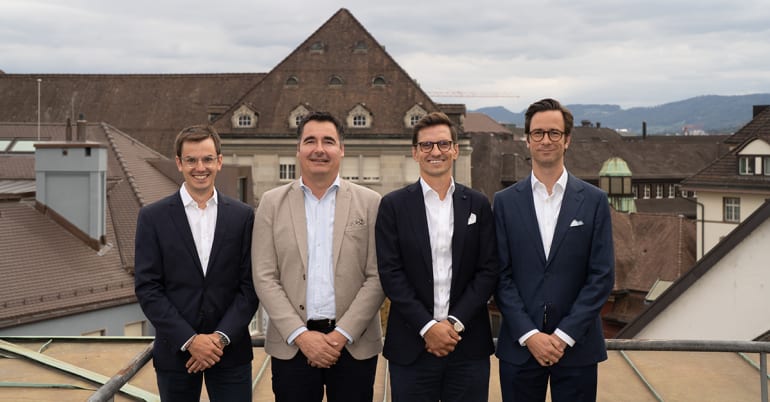
Giovanni Bizzozero, Portfolio Manager; Markus Thöny, Head of Swiss Fixed Income; David Perez, Portfolio Manager; Philipp Burckhardt, Portfolio Manager
key takeaways.
LOIM’s Swiss Fixed Income team has continually refined its investment process over the past 18 years while remaining true to a consistent investment philosophy
Markus Thöny, LOIM's Head of Swiss Fixed Income, reflects on the foundations of his team’s long-term track record, including the importance of disciplined risk-taking and client communication
He discusses the evolution of the Swiss franc corporate bond market, changing client expectations, and the key risks and opportunities shaping Swiss fixed income today.
Successful fixed income investing rests on a combination of people, process and performance, in our view. LOIM's Swiss Fixed Income strategy is built on these foundations. This year, Swiss Franc Credit Bond surpassed CHF 2 billion in assets under management, a key milestone.
In the following Q&A, Markus Thöny, Head of Swiss Fixed Income, reflects on nearly two decades of managing the strategy and preserving value through market cycles. He discusses the team’s investment philosophy, lessons from past market crises, the importance of client trust and what may lie ahead for Swiss fixed income.
Q: Your track record has been established across very different market environments. What has been key to delivering those results?
A: Performance is always our first priority. It starts with outstanding investment professionals and an investment process that reflects our philosophy.
Our philosophy is built on accountability and ownership. We empower our investment specialists to do what they do best – apply their expertise directly to portfolios and make investment decisions within clearly defined risk budgets. We believe that decisions should be made by those with the deepest expertise, closest to the opportunity and fully accountable for the outcome. This creates a culture of responsibility, agility and performance.
Equally important is the way we serve our clients. We believe that trust must be earned every day through integrity, professionalism and consistent execution. Our commitment is to deliver what we promise and to ensure our portfolios reflect the investment approach we communicate to clients.
Ultimately, our goal is to generate strong investment results and be a trusted long-term partner for our clients1.
sign up for our monthly newsletter.
Thank you for subscribing to our monthly newsletter!
There was an error registering your subscription. Please email loim-digital@lombardodier.com.
Q:Have market developments prompted meaningful changes to your approach, or have its core principles stood the test of time?
A: Our philosophy has remained unchanged since the strategy’s inception in June 2008. At the heart of our process is a clear distinction between beta and alpha generation. Benchmark replication and cash management are handled by dedicated replication specialists. Alpha generation is done through a multi-PM approach, in which skilled investment professionals apply their specialist expertise to contribute differentiated and largely uncorrelated return streams.
A robust investment process must be consistent with the investment philosophy, but also scalable and adaptable. While the core principles haven’t changed, we have continuously refined the process over the past 18 years by adding new alpha sources and incorporating systematic hedging strategies. This combination of consistency and innovation has been a key driver of our long-term success.
Stability, complementary skill sets and deep experience combine to create a truly collaborative platform, united by a shared commitment to delivering consistent outcomes.
Q: The strategy was launched at the height of the global financial crisis. You then managed it through the eurozone debt crisis, the era of negative Swiss interest rates and the post-pandemic inflation shock. How did the strategy respond to these very different environments?
A: As active managers, we seek to take active risks. By definition, this means we won’t always get every investment decision right. We were at times unable to keep pace with the benchmark. However, temporary underperformance was always followed by strong outperformance2, underpinning our confidence in our active investment approach over the medium to long term.
In periods of stress, we place great importance on transparent communication so that clients understand what has happened, how portfolios have been affected and how we’re responding.
“Temporary underperformance was always followed by strong outperformance2, underpinning our confidence in our active investment approach over the medium to long term.”
- Markus Thöny, Head of Swiss Fixed Income
Uncertainty is often amplified by a lack of information. We are therefore committed to providing timely, transparent and honest updates. Keeping clients informed about developments, risks and our assessment of the situation helps build trust and supports well-informed decision-making. Clear communication, combined with disciplined investment management, is the foundation of successful crisis management.
Investment decisions start with a rigorous assessment of both issuer fundamentals and portfolio-level risk. When investing in lower-rated credits, for example, broad diversification is essential to managing risk. Systematic hedging strategies can also mitigate downside risk and portfolio volatility during periods of market stress.
At the same time, market dislocations often create some of the most compelling opportunities, as temporary dislocations can emerge between market prices and underlying fundamentals. Our credit specialists’ deep understanding of issuers and markets enables us to assess risks with confidence and identify attractive risk-return opportunities through disciplined and selective investing.
Ultimately, we view market dislocations not only as periods of heightened risk, but also as opportunities to create long-term value for our clients. Success depends on strong risk awareness, disciplined risk-taking and the conviction to act when opportunities arise.
Q: Over the years, how have investors’ needs and expectations changed, and what do you think drives loyalty and repeat business?
A: Professional client service is crucial and has become even more so in recent years. Open, transparent, timely and consistent communication, supported by insightful analysis, is essential for building and maintaining trust.
While clients continue to prioritise strong performance and competitive fees, their expectations have evolved. Reporting requirements have become more demanding, particularly in areas such as sustainability, so we must be able to address a broader range of client needs. We benefit from extensive in-house sustainability expertise, which enables us to meet these requirements consistently and effectively.
At the same time, we strive to demonstrate the value of active management to an investor community that remains largely focused on passive solutions. Our growing success in attracting these investors reflects their confidence in our expertise, disciplined process and long-term results.
We view client service as a core element of our value proposition. Trust, transparency, responsiveness and a commitment to meeting clients' needs are what build lasting relationships.
Q: How has your market changed over the years from an issuance perspective, and what trends stand out today?
A: The Swiss franc corporate bond market has undergone several distinct phases. Following the financial crisis, the market expanded significantly in both size and number of issuers as companies sought to diversify their funding sources and reduce reliance on traditional bank financing.
During the period of ultra-low and negative interest rates, as well as in times of market stress, domestic issuers tended to dominate primary market activity. More recently, however, international borrowers have returned to the Swiss franc bond market in greater numbers. This year, most notably, the hyperscalers Alphabet and Amazon3 have accessed the Swiss franc bond market. Other large borrowers, including Novo Nordisk, L’Oréal and Mondelez3, have also come to market with multiple-tranche deals, attracting strong investor demand.
“Trust, transparency, responsiveness and a commitment to meeting clients' needs are what build lasting relationships.”
- Markus Thöny, Head of Swiss Fixed Income
Based on current issuance trends, 2026 is on track to become a record year for primary market volumes in Switzerland. At the same time, we can see sustained and solid demand for Swiss fixed income offsetting this primary market supply, with significant investor flows into the corporate credit space.
Meanwhile, the Swiss franc sub-investment-grade segment continues to shrink, further highlighting the strong overall credit quality of the Swiss franc corporate bond market. The issuer base remains predominantly high-quality with exceptionally low default risk, making it an attractive investment universe for credit investors seeking a good risk-return profile.
Q: What are the main risks or market developments you are watching most closely today?
A: Right now we see the greatest risks stemming from geopolitical developments and their potential impact on economic growth, inflation and employment.
Given the current global backdrop, we find it difficult to fully reconcile the prevailing market optimism with the risks we see on the horizon. We are, therefore, currently positioned somewhat more cautiously than we have been in the past.
That said, our cautious stance should not be mistaken for a lack of conviction. Rather, it reflects a disciplined and risk-aware approach to investing in an environment where uncertainty remains elevated and the balance between risks and opportunities has become less clear-cut.
Q: What do you see as the most important themes shaping the outlook for your market in the years to come?
A: Our primary objective is clear: to outperform the benchmark over the long term. While all-in yield levels remain relatively modest due to still-low interest rates, we continue to see value in the compensation for credit risk. As a result, we maintain an overweight allocation to credit.
In the current environment, corporate bonds are particularly appealing because they typically carry less interest rate risk than government bonds.
At the same time, volatility in the Swiss franc credit market remains exceptionally low, making carry trades the dominant source of returns. As is always the case with carry strategies, rigorous credit analysis is critical. Generating attractive returns requires a deep understanding of issuers, careful risk selection and continuous monitoring of underlying fundamentals.
If market volatility returns, it will be essential to capitalise on the new opportunities that emerge. Ultimately, sustainable outperformance can only be achieved by taking well-researched and risk-aware investment decisions. Investors who can act decisively and selectively will be best positioned to generate long-term outperformance.
To learn more about our Swiss Franc Bonds strategy, click here
view sources.
+
[1] Target performance is an estimate of future performance based on current market conditions and is not an exact indicator. What you will get will vary depending on how the market performs and how long you keep the product.
[2] Past performance is not a guarantee of future results.
[3] Any reference to a specific company or security does not constitute a recommendation to buy, sell, hold or directly invest in the company or securities.
important information.
For professional investors use only
This document is a Corporate Communication for Professional Investors only and is not a marketing communication related to a fund, an investment product or investment services in your country. This document is not intended to provide investment, tax, accounting, professional or legal advice.