When you visit our website, information may be stored or recovered on your device, mainly in the form of cookies. We use essential cookies to ensure the website works as it should, and statistical and marketing cookies for audience measurement and content customisation purposes. We rely on Google to store your consent choices and manage the activation of cookies accordingly. For more information on this, please also refer to the Google policy on Business Data Responsibility.
From the Cookie Management Centre, you can set your preferences with respect to the use of cookies: accept or reject certain categories, accept all, or reject all. For detailed information on all cookies used across these three categories, please refer to our Cookie Policy.
Please note that blocking certain cookies may affect your experience and the services offered.
Essential cookies Always active
Essential cookies help the website to work as it should by enabling necessary functionalities, such as navigating between pages and accessing secure areas. These cannot be disabled in our systems.
Statistical cookies
Statistical cookies help us understand how visitors interact with our site by collecting and communicating browsing information. They make it possible to identify the most and least visited pages and to improve the overall performance of the site.
Marketing cookies
Marketing cookies are used to display relevant advertising and measure the performance of campaigns. If you choose not to allow these cookies, you will continue to see ads, but they will be less relevant to your interests.
Choose the purposes for which we may use Google products to collect and use your data:
User storage: to technically permit advertising functionality.
User data for advertising: to optimise our advertising campaigns.
Ad customisation: to tailor advertising to your interests.
Reimagining finance for a nature-first economy: HM King Charles III supports the Circular Bioeconomy Alliance UK launch
key takeaways.
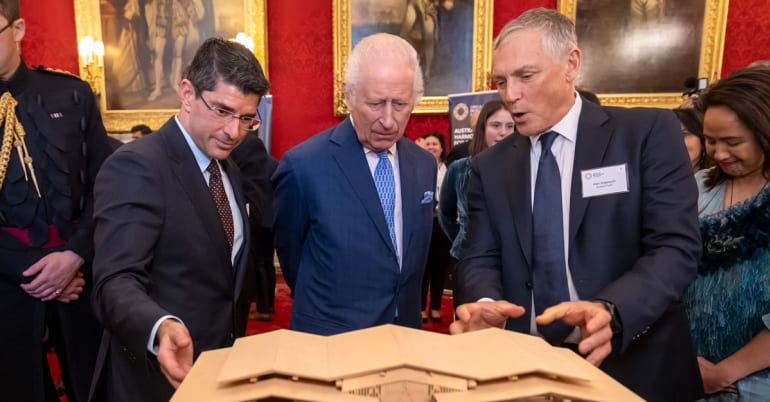
His Majesty King Charles III hosted indigenous leaders, scientists and investment-industry executives at St James’s Palace to officially launch the Circular Bioeconomy Alliance in the UK
The event focused on pragmatic solutions involving policymakers, the private sector and communities to transition from an extractive economic model to a circular bioeconomy focused on nature and efficient reuse
Live case studies from the coffee, cotton and wool industries were examined to show how value chains that have become climate- and nature-positive can also be more resilient and commercially successful.
On 21 November, over 100 global figures – including indigenous leaders, scientists and experts in business and finance – gathered at St James’s Palace in London for the UK launch of the Circular Bioeconomy Alliance (CBA), hosted by His Majesty King Charles III.1
The event examined practical, on-the-ground examples of how today’s economy can shift from an extractive model to a circular bioeconomy based on nature and efficient reuse, and how innovative nature-based financing and investments could accelerate the transition.
The focus of the event was ‘action’ – moving beyond ideas to implementing pragmatic changes so that economic activity can at first halt, and then begin to reverse, the devastating impacts of climate change and biodiversity loss while simultaneously fostering growth.
Negative externalities are now internal to the economy
Marc Palahí, CEO at the CBA and Chief Nature Officer at LOIM, the sustainable investment platform of Lombard Odier Investment Managers, gave the event’s keynote speech, warning those in attendance that 100 years of an extractive, wasteful, fossil resource-based economy have brought us to “a tipping point in human history”.
“Nature is the keystone infrastructure that regulates our planetary system,” he began. “It supports all living processes on Earth. It also supports our economic activities – even if we don’t realise that because trees, birds and bees don’t send us bills.”
“We have seen unprecedented economic growth and technological development, but we have achieved this at the expense of nature, the climate, and even our own future. We have crossed nature’s ‘planetary boundaries’ – the safe operating spaces for our planet. The problem is that the different risks – such as climate change, biodiversity loss, etc – begin to accelerate each other.
“For example, when we lose biodiversity and forests we are not only weakening our most important terrestrial carbon sink, but we also release huge amounts of carbon into the atmosphere. In turn, that will accelerate climate change and result in more frequent and intense extreme events like wildfires, which will burn more forests. We enter into a vicious cycle.”
“Very simply, our environment can no longer absorb the shocks that our economy generates, which means our economy must absorb its own shocks. Externalities have become internal to the system. This is what is already happening. If you look at global insured losses due to climate change and nature degradation, they have doubled in only five years.”
Pulling back from the tipping point
However, by making Nature our economic partner, we can pull back from the tipping points we face, Palahí said.
“The good news is that we have the knowledge and technology to build an entire new economy anchored around nature-based solutions as the basis for circular bioeconomy value chains. These can deliver ecosystem services rather than environmental externalities; and bio-based alternative materials can replace, and outperform, fossil-based inputs across all economic sectors."
“This is a ‘nature-first’ economy. It is about understanding, valuing and investing in nature as the true engine to transform our economy, rather than to offset for its failure. It is about moving from offsetting to insetting strategies3 that deliver transformational action. This is the most cost-effective strategy."
“The greatest challenge we are facing is not the lack of knowledge, the lack of technology, the lack of regulations, or even the lack of capital. The greatest challenge is the extractive mindset we have created. We need to move to a regenerative mindset.”
The greatest challenge is the extractive mindset we have created. We need to move to a regenerative mindset.
The nature-first approach: turning coffee into a carbon sink
Emphasising the event’s focus on pragmatic action, Palahí cited coffee production as an example of the nature-first approach. Much of today’s coffee production, he explained, “takes place in monocultures which require chemical inputs in the form of pesticides and fertilisers. On average, for every one kilogram of coffee produced, around 22 kilograms of CO₂ are emitted.”
Instead, he said, “a nature-based approach – known as agroforestry – uses only biological inputs, deploys crop diversity, and boosts natural ecosystem services such as insect pollination. By doing so, coffee production can absorb 4-10 kilograms of CO₂ for every kilogram produced, while the system also becomes more resilient to climate change. You go from net-negative coffee to nature- and climate-positive coffee production.”
Morten Rossé, Head of Nature and Climate at LOIM, expanded on this example, explaining that existing agroforestry projects show that nature-positive coffee is already a proven concept . It forms a key part of LOIM’s nature approach. Today, he said, just USD 200 billion of investment is flowing into nature-based climate solutions, while USD 7 trillion of finance is flowing into activities that are actively harming nature.6
LOIM aims to turn this tide by showing that there need be no trade-off between impact and returns. At the core of the investment case, he explained, is that huge swathes of brownfield agricultural land are currently undervalued. By upgrading them to a nature-based, regenerative model, they will produce commodities sold for a premium to contracted corporate off-takers seeking to reduce their supply chain emissions. In time, the land will become a net carbon sink and protective canopies make the crops increasingly resilient to climate change and extreme weather events. In this transition from an increasingly vulnerable monoculture to a sustainable agroforest producing premium commodities, the land should appreciate in value.
For investors, nature-based assets offer a chance to take part in potentially the most significant asset revaluation in a generation.
The focus on taking action continued with an exploration of the CBA’s ‘Living Labs’, on-the-ground projects that are implementing nature-first principles for producing wool and cotton for the fashion industry.
Giuseppe Marsocci, Deputy Managing Director at Armani Group, explained how the CBA’s Living Lab in Puglia, Italy, is demonstrating that cotton – which is currently one of the world’s most unsustainable crops7 – can be grown regeneratively in an agroforestry setting, cutting its water intensity and making it part of a healthy, bio-diverse landscape. Delegates heard that while the project is starting small, the clothing produced from the regenerative cotton will be highly desirable and, once the system is proven, production will be scaled up.
A similar story was told by Riccardo Stefanelli, CEO at Brunello Cucinelli, which has partnered with the CBA to create a Living Lab in the Himalayas. There, regenerative principles are being applied to farming Pashmina goats for their famously fine wool. Riccardo Stefanelli showed HM King Charles III and event delegates the first handmade pashmina items made using wool from the project.
This is enhancing biodiversity, enriching lives, tackling climate change and delivering a good financial return. This is the future for finance.
Innovating to reimagine nature finance
The event heard that to transition to a nature-first economic model at scale, we will need an overhaul of nature finance and an innovative approach to nature-based investing.
Launching the Sir Evelyn De Rothschild Fellowship for Reimagining Nature Finance and Inclusive Capitalism, a collaboration between the ERANDA Rothschild Foundation and the CBA, Lady Lynn Forester de Rothschild, Chief Executive, E.L. Rothschild LLC, explained that the transition will require policy and financial frameworks that encourage the deployment of capital at scale. While voluntary markets for carbon and biodiversity credits will remain part of the toolkit, she noted, we must continue to innovate, including via potential hybrid finance models that look beyond standard market-based approaches.
At LOIM, we are convinced that investors have an essential role to play in this transformation by deploying capital in ways that drive potential returns while simultaneously scaling the growth of nature-based business models and the rise of a circular bioeconomy. Part of this will be achieved through stewardship, by encouraging and incentivising companies to develop nature-positive supply chains. First, however, comes the fundamental decision about where to invest.
As Marion Maloney, Head of Investment at the Environment Agency Pension Fund, which is working with LOIM to develop the nature-investment strategy for the pension scheme, explained: “The most powerful tool our pension fund has to drive positive change is choosing where to invest. The Environment Agency Pension Fund has chosen to invest 4% of our assets in nature – about GBP 200 million. This is enhancing biodiversity, enriching lives, tackling climate change and delivering a good financial return to boot. This is the future for finance.”
subscribe to LOIM investment insights and strategy reports
click here
view sources.
+
1 LOIM, as part of the Lombard Odier Group, has been a founding member of the CBA since it was established by The King in 2020 as the Prince of Wales.
3 Insetting refers to real, direct, immediate emission reductions achieved within corporate value chains rather than by the purchase of external offsets.
This document is a Corporate Communication for Professional Investors only and is not a marketing communication related to a fund, an investment product or investment services in your country. This document is not intended to provide investment, tax, accounting, professional or legal advice.