When you visit our website, information may be stored or recovered on your device, mainly in the form of cookies. We use essential cookies to ensure the website works as it should, and statistical and marketing cookies for audience measurement and content customisation purposes. We rely on Google to store your consent choices and manage the activation of cookies accordingly. For more information on this, please also refer to the Google policy on Business Data Responsibility.
From the Cookie Management Centre, you can set your preferences with respect to the use of cookies: accept or reject certain categories, accept all, or reject all. For detailed information on all cookies used across these three categories, please refer to our Cookie Policy.
Please note that blocking certain cookies may affect your experience and the services offered.
Essential cookies Always active
Essential cookies help the website to work as it should by enabling necessary functionalities, such as navigating between pages and accessing secure areas. These cannot be disabled in our systems.
Statistical cookies
Statistical cookies help us understand how visitors interact with our site by collecting and communicating browsing information. They make it possible to identify the most and least visited pages and to improve the overall performance of the site.
Marketing cookies
Marketing cookies are used to display relevant advertising and measure the performance of campaigns. If you choose not to allow these cookies, you will continue to see ads, but they will be less relevant to your interests.
Choose the purposes for which we may use Google products to collect and use your data:
User storage: to technically permit advertising functionality.
User data for advertising: to optimise our advertising campaigns.
Ad customisation: to tailor advertising to your interests.
Fixed Income Strategist and Senior Portfolio Manager
key takeaways.
The Swiss National Bank (SNB) delivered a substantial interest rate cut, surprising the market and reigniting talk of negative rates
Recent policy statements show how the bank dialled up and down its signalling, including its intentions in currency interventions
An uncertain global outlook is likely to drive future moves as well as the policy mix.
SNB dials up the urgency with a sizeable rate cut
The Swiss National Bank delivered a substantial interest rate cut at its December meeting in a larger-than-expected move that again showed its predilection for surprising the market and brandishing its policy firepower.
Citing a decrease in underlying inflationary pressure, the bank slashed rates by 50bps to 0.50%. The majority of analysts had expected a smaller, 25bps move. The cut deviated from the bank’s more typical 25bps increments, signalling urgency and the need to act decisively to tackle inflation moving out of the targeted range.
As it aims to keep the Swiss franc unattractive by maintaining the rates differential to euros and US dollars, the SNB was also protecting its mandate and following through on the dovish signalling from its September meeting, when the bank opened the door to more rate cuts.
A signalling tale through three statements
Indeed, the last three SNB statements illustrate how the bank dialled up and down its signalling. As it cut rates in June 2024, the bank’s assessment stated that it would monitor inflation closely and further adjust policy “if necessary”. By September, however, the assessment escalated its intention by clearly stating that “Further cuts in the SNB policy rate may become necessary in the coming quarters to ensure price stability over the medium term.” Most recently, the December assessment – and with 100bps of rate cuts in just three meetings now under the bank’s belt – the bank has reverted to the less committed language from June of monitoring the situation and adjusting if necessary.
In the past, the bank has used surprise as a mechanism to increase the effectiveness of its policy both with larger-than-forecast rate moves and the shock removal of the CHF/EUR exchange-rate cap in 2015. Both the beginning of its rate hiking and rate cutting cycles (in 2022 and 2024 respectively), were also a surprise in terms of timing.
Delivering a 50bps decrease quickly should mean the SNB needs to make fewer cuts in total. Larger increments enable central banks to be aggressive and bold, in turn reducing the need for future policy moves. This was the case for the Federal Reserve’s (Fed) rate hikes in 2022, when it preferred a series of relatively larger moves with regards to historic episodes of 75bps.
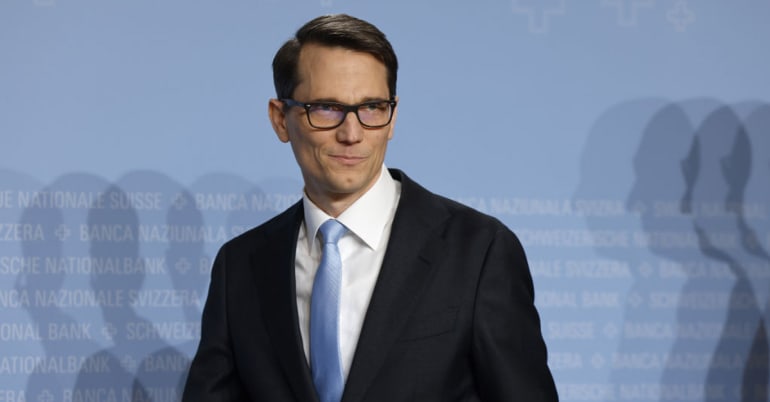
As for market speculation that Swiss rates could move back into negative territory, Schlegel pointed out that the December rate cut should stabilise the bank’s inflation forecast and reduce the probability of future rate cuts through zero.
What price context underpinned the SNB’s loosening?
The anticipation of more deflationary forces in 2025 galvanised the bank’s decision. Energy prices are expected to fall in the new year and could further diminish inflation. In the property market, the reference interest rate that is used to set Swiss rental prices is also expected to fall alongside mortgage rates. This would lower rents in the new year and further depress prices.
Fig 1. Swiss mortgage rates vs the reference rate1
As always, the currency was also key. The SNB reiterated the development of the Swiss franc is still ‘an important factor’ and that it remains willing to intervene in the foreign exchange (FX) market as necessary. That said, it also pointed to policy rate cuts as the “main instrument” should monetary policy need to be eased further.
The bank seemingly also sought to show its resolve to not tolerate further currency appreciation and put an early end to possible speculation in FX markets. A larger cut removes imminent pressure on the bank to engage in FX interventions and protects the balance sheet from further expansion, in our view. And the bank’s language seems to presage that the SNB will make greater use of monetary policy over FX interventions.
subscribe to LOIM investment insights and strategy reports
click here
An expansionary rate amid uncertainty
At 0.50%, we consider Swiss interest rates to be at the lower end of ‘neutral’ and hence slightly expansionary. This contrasts with rates in the eurozone and US, which are both still in the restrictive range. The European Central Bank (ECB) trimmed 25bps from rates at its December meeting and dropped previous references to keeping rates restrictive for as long as necessary. Should eurozone rates continue to drop, the SNB will be keen to halt potential strengthening of the franc.
The SNB is ending the year by following through on its previous, dovish messaging and keeping momentum on its side with a larger-than-anticipated rate reduction. Looking forward, the global outlook remains uncertain due to the new Trump administration, trade tensions, geopolitical risks and a deteriorating eurozone economy. These could potentially prompt a negative shock to the Swiss economy and firm the currency. Even if it clearly dislikes negative rates, we believe the SNB would react to potential developments primarily through rate reductions and will complement the policy mix with FX interventions if rates approach negative territory or the appreciation of the Swiss franc accelerates.
To learn more about our Swiss Franc Bonds strategy, click here
view sources.
+
1 Source: SIX, BWO, SNB, LOIM calculations. Data as at 17 December 2024. For illustrative purposes only. SARON is the Swiss Average Rate Overnight and measures the overnight interest rate of the secured funding market denominated in CHF.
important information.
For professional investors use only
This document is a Corporate Communication for Professional Investors only and is not a marketing communication related to a fund, an investment product or investment services in your country. This document is not intended to provide investment, tax, accounting, professional or legal advice.